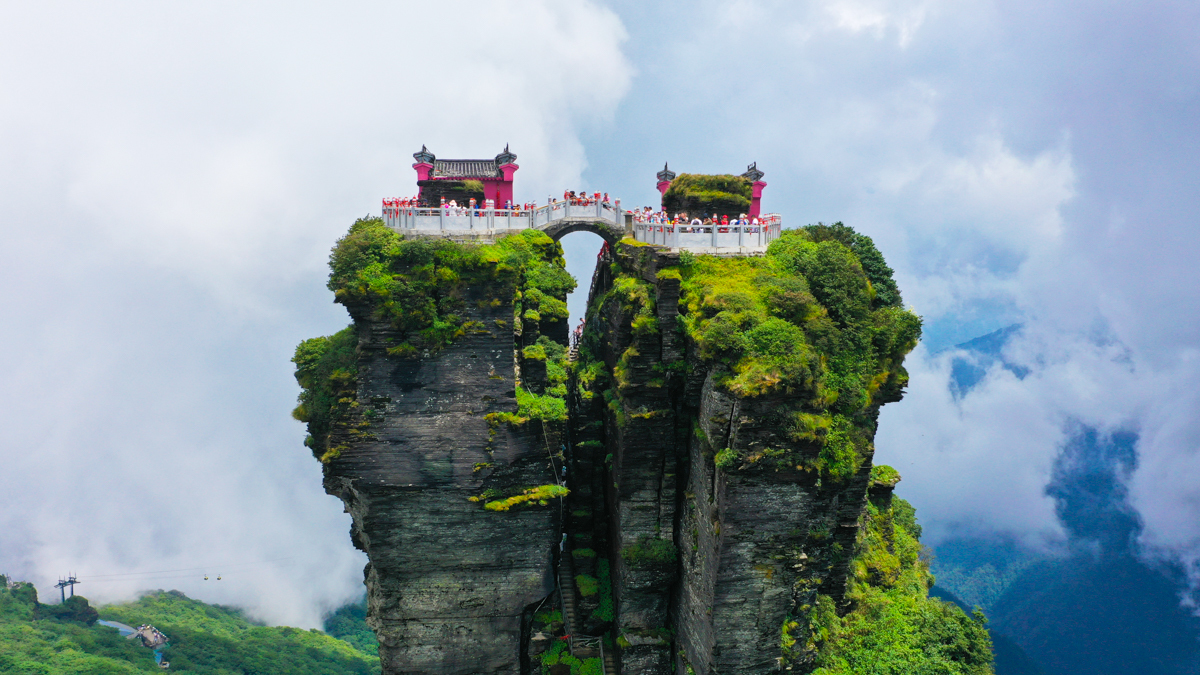
Lushan Mountain—also known as Kuangshan or Kuanglu—is located within the jurisdiction of Lushan City, under the administration of Jiujiang City, Jiangxi Province. Rising above the plains of the middle and lower reaches of the Yangtze River, Lushan stands with the Yangtze River to its north and Poyang Lake to its east. The convergence of this grand mountain, the great river, and the vast lake creates a magnificent landscape, rare anywhere in the world. Spanning approximately 25 kilometers in length and 10 kilometers in width, the mountain is situated between 115°52′—116°8′ E longitude and 29°26′—29°41′ N latitude. Its main peak, Hanyang Peak, reaches an elevation of 1,474 meters. The mountain mass is elliptical in shape and serves as a classic example of a horst—a block of the Earth's crust uplifted between faults.
In 1982, Lushan was designated by the State Council as one of the first groups of National Key Scenic and Historic Interest Areas. On December 6, 1996, it was inscribed by UNESCO as a World Cultural Heritage site. In 2003, it was named one of the "Top Ten Famous Mountains in China." On February 13, 2004, it was included among the first group of Global Geoparks. On March 7, 2007, it was rated as a National 5A-level Tourist Attraction. In May 2022, the "sea of clouds" at Lushan was selected as one of the first 15 "weather and climate landscape viewing sites" in China, as announced by the China Meteorological Service Association.