
Seniors China Tours: Comfortable China Travel for Older Travellers
Most China itineraries are built for stamina. This page is built for the other half of the market: travellers in their sixties, seventies and eighties who want the same country at a pace that fits, with the paperwork, the walking distances and the medical practicalities worked out in advance rather than discovered on the day.
The sixty-second answer
Tell us the pace, and we build the itinerary around it.
Plan a senior-friendly itinerary Send us the ages, the cities you care about, and any mobility or medical constraints. You get a day-by-day plan with walking distances and vehicle times shown, so you can approve it against what you actually want to do.What actually changes with age, and what does not
There is a genre of travel writing about older travellers that begins with the word “still”. Still travelling. Still adventurous. Still young at heart. It is meant kindly and it is useless, because it answers a question nobody asked. The question is not whether a seventy-four-year-old can enjoy China. It is which parts of China get harder, by how much, and what a tour operator can do about each one.
So this is the honest version. Four things genuinely change with age, and they change at different rates for different people. Three things that people expect to change mostly do not.
What changes
Walking distance, and more precisely walking distance without a seat. This is the single biggest variable, and it is not the same thing as fitness. A fit seventy-year-old who has had a knee replacement has a hard daily ceiling that a softer seventy-year-old with no joint trouble does not. Chinese heritage sites are large in a specific way: the Forbidden City is roughly 960 metres from the Meridian Gate to the Gate of Divine Prowess, before you count the courtyards you cross sideways, and the walking is nearly all on hard paving with few benches and very little shade in summer.
Recovery time between full days. A twenty-eight-year-old can do five consecutive sightseeing days and absorb it. Most travellers past seventy can do three before the fourth becomes a chore rather than a pleasure. This is the reason a well-built senior itinerary has rest built into the middle of it rather than at the end, where it is usually too late to help.
Thermal regulation and hydration. Older bodies handle heat less efficiently and feel thirst later, which is a bad combination in a Chinese summer. July in Beijing and August in Shanghai are the two hardest months on this page, and they are also the months when school holidays push both prices and crowds up. June and September are the better trade.
The paperwork. This is the change travellers underestimate most. From a certain age, some routes start asking for documents — a health certificate, a signed responsibility letter, sometimes a named companion. Nothing about this is uniform, and it is not written in one place. We come back to it with the specifics in the rail and high-altitude sections below.
What mostly does not change
Interest. If anything the opposite. Guides in Xian report that their best questions come from travellers who learned the dynasties forty years ago and have been waiting to see the objects. Depth of interest is why a slow itinerary works: you are not cutting content, you are cutting the queueing and the walking between it.
The ability to enjoy a long train journey. High-speed rail between Beijing, Xian, Shanghai and Guilin is genuinely restful in a way that flying is not — you stay seated, keep your luggage, and watch the country change. For a traveller with reduced mobility it is also materially easier, because a station assistance booking removes the hardest parts of the day.
Appetite for the food. Chinese regional cooking is not a barrier for older palates; if anything it suits them, being largely soft-cooked, vegetable-forward and served warm in courses. The real constraint is spice and oil in some regional kitchens, which is easy to plan around once we know your preferences.
What this page does not do
- It does not rate your fitness or decide whether you should travel. A doctor who has examined you does that.
- It does not promise that a discount or an assistance service will be available on any particular day. Both are published policies, and both change.
- It does not quote a price. The ranges shown later come from this operator’s own published tour pages, and a real quotation depends on your dates, hotel tier and party size.
Do the senior discounts apply to a foreign passport?
China’s senior ticket discounts are real, and in Beijing they are unusually generous: free entry at sixty, not a token percentage. They are also written for a domestic audience, and the published wording of a Chinese ticket policy usually names a shenfenzheng — the national identity card. That single word is the whole question for a visitor holding a passport, and the answer is not the same at every gate.
We checked three of the most-visited sites in Beijing against their own published sources, and the results genuinely differ. Two of them state plainly that the benefit reaches foreign visitors. One does not say either way.
| Site | Age | Published benefit | Foreign passport | Where this comes from |
|---|---|---|---|---|
| Temple of Heaven Park天坛公园, Beijing | 60+ | Free admission | Yes, stated | The park’s ticket screens advertise free entry at 60 and above, and staff confirmed to reporters that the policy covers foreign visitors, who show the birth date on a passport or another valid identity document at the gate. |
| Summer Palace颐和园, Beijing | 60+ | Free admission, no advance ticket needed | Yes, stated | An official answer on the Beijing government’s English service desk, from the Beijing Municipal Administration Center of Parks, tells a 64-year-old foreign visitor to present a passport, a permanent residence card or another valid identity document at the verification lane. |
| Palace Museum故宫博物院, Beijing | 60+ | Half price | Not stated | The published clause grants half price to visitors of 60 and above who present a valid identity card. A passport is not named in that clause. Treat it as unconfirmed and ask at the ticket desk. |
Scroll the table sideways to see every column.
What the Palace Museum actually charges
The Forbidden City is the one site on this page where the arithmetic matters enough to set out in full, because it runs a seasonal two-tier price and sells its two palace galleries separately. The senior rate is exactly half the standard rate, applied to all three tickets.
| Ticket | Standard | Senior rate, 60+ |
|---|---|---|
| Main gate, peak season1 April to 31 October | CNY 60 | CNY 30 |
| Main gate, off-peak1 November to 31 March | CNY 40 | CNY 20 |
| Treasure GallerySold separately | CNY 10 | CNY 5 |
| Clock and Watch GallerySold separately | CNY 10 | CNY 5 |
Scroll the table sideways to see every column.
Two operational points matter more than the money. First, the Palace Museum does not sell same-day tickets at all: presale opens at 20:00 exactly seven days before the visit date, and the allocation for popular mornings goes quickly. A senior traveller who has not booked seven days ahead will not get in, whatever the discount. Second, the gallery tickets are a separate purchase from the main gate, and they are the part of the visit most older travellers actually remember — the clock gallery in particular, because it is indoors, seated in stretches, and out of the weather.
There is one more detail worth knowing, not for your own visit but for understanding why your operator behaves the way it does. The Palace Museum publishes a no-show rule for trade accounts: an agency whose monthly refund-and-no-show rate exceeds 20 per cent loses its group booking rights for the following month. That is why a careful operator will ask you to confirm dates before it books anything it cannot get back, and why it may be reluctant to hold loose provisional bookings across a long itinerary.
How to handle discounts in practice
- Carry the passport itself, not a photocopy. Every policy quoted above requires an original document with the birth date on it. A phone photograph has not worked at any ticket office we can find evidence for.
- Buy at the desk if the website will not cooperate. Online ticketing systems apply concession rules through a nationality field that often has no passport option. The counter staff can see the date of birth and apply the rule directly, and at the Temple of Heaven they are described as volunteering the discount before being asked.
- Do not build the budget around a discount you have not confirmed. Entry fees at Chinese heritage sites are a small line in a tour budget next to hotels and transport. Treat any senior saving as a bonus and you will never be disappointed by it.
- Expect the discount to be per person and non-transferable. It is tied to the document, and it does not extend to a younger companion or carer.
Rail, and the assistance service most travellers never book
If you take one practical point away from this page, take this one. China Railway runs a published assistance service for passengers who need help getting through a station, it is free, and the overwhelming majority of foreign visitors never use it — because almost nothing written in English mentions that it exists. On a long itinerary with four or five rail legs, it is the difference between a station being the hardest part of the day and it being the easiest.
The service is called zhongdian lüke — priority passenger — booking. There are five categories, and the one that matters here is the unaccompanied older passenger, defined as generally over 65, travelling alone and with limited mobility. The other four cover unaccompanied pregnant passengers, visually or hearing impaired passengers, wheelchair and stretcher users, and passengers travelling with a guide dog.
What you get
| What the service covers | Detail |
|---|---|
| Getting in and out | Assistance through station entry and exit, with priority at security screening, identity verification and boarding. A staffed channel is kept at the ticket gates for older passengers and children. |
| On the platform | Guidance and physical support, including help boarding and alighting the train itself, which is where the gap between platform and carriage floor causes most trouble. |
| Equipment, free of charge | A wheelchair or stretcher inside the station, provided at no cost. This is a station wheelchair to get you to the train, not a wheelchair for the journey. |
| On board | The station hands over to the train crew, who provide follow-up attention during the journey. At the arrival station, staff can escort you out. |
| Waiting | Stations with a priority passenger lounge or a nursing room provide a separate waiting area. |
| Where it applies | From the assistance meeting point at the station entrance to the gate at the exit. It does not cover the journey to or from the station. |
Scroll the table sideways to see every column.
How to book it, and the deadline that catches people out
There are two channels and two different deadlines, and the online one is the one to use because it lets you arrange the whole itinerary before you fly.
- Online, at least six hours before departure. Through the 12306 website, the 12306 app, the 12306 telephone hotline, the Railway Smooth Travel code, or the China Railway WeChat official account. If you book through an operator, this is part of what you are paying them to do.
- At the station, at least sixty minutes before departure. At the 12306 service desk or the comprehensive service centre. You can also ask on the train, but by then the difficult part is behind you.
- One booking per leg. If the journey involves a change of train, each segment needs its own request. A Beijing-to-Guilin routing with a change in Changsha is two requests, not one.
- Bring proof. The railway checks that the passenger’s identity matches the ticket and reserves the right to decline if documentation does not support the service condition.
Two benefits that start at sixty, and one catch
Separately from the assistance service, China Railway applies two conveniences from age sixty, confirmed in a published reply from the railway group’s passenger department.
Priority allocation of a lower berth. When you book a sleeper, the 12306 system allocates a lower berth in preference for passengers of sixty and above. On an overnight leg this is not a small thing: a lower berth removes the ladder entirely, and the ladder is the single most hazardous object in a Chinese sleeper carriage for an older traveller.
Telephone booking. From sixty, you can book by telephone between 08:00 and 18:00 daily for travel three days ahead or further, and the agent will select and book the seats for you.
The catch is worth stating plainly, because it appears in the published wording and almost nowhere else. The telephone booking route is written for holders of a second-generation Chinese identity card. A visitor travelling on a foreign passport cannot use that specific channel. The lower-berth preference and the assistance service both remain available, but the friendly human on the end of the phone who books the ticket for you is a domestic-resident benefit. Plan around it: book rail through your operator, and use the assistance service, which does not depend on nationality.
Pacing: choose a tier before you choose a city
Almost every China itinerary is designed the same way: pick the cities, then fill the days. For an older traveller that order is backwards. The cities you can enjoy are a consequence of the daily shape you can sustain, not the other way round. Decide the shape first and the city list falls out of it — usually with fewer places and better days.
We build senior itineraries in three tiers. They are not ability levels, and nobody is graded. They are simply three different daily shapes, and each one has honest consequences for what fits.
Gentle
Steady
Active
The tiers are not fixed for the whole trip. A common and very workable pattern is to start at one tier, spend the first three days there, and lift it if the traveller is sleeping well and feeling strong. The reverse is harder to arrange, because a hotel and a guide are already booked. If you are unsure, choose the gentler tier and plan to upgrade on the ground.
Work out which tier fits
Six questions, no scoring jargon. Answer them for the person who finds the walking hardest, not for the fittest member of the party — the itinerary has to work for everyone, and the slowest walker sets the pace of every day.
Answer all six questions and we will place the trip in one of the three tiers above, with the daily numbers that follow from it.
Two things the tool cannot see. It cannot see how you are sleeping, and it cannot see whether you are travelling with someone whose needs pull in a different direction. Both matter more than the score. Send us the result together with a sentence about each, and the itinerary will be better than any questionnaire can make it.
The cities that work, and what to actually do in each
These four are the backbone of almost every senior itinerary we build, and they are not chosen for the obvious reason. It is not that they are the most famous. It is that all four have a high ratio of seated and indoor quality to walking — long stretches where the best thing to see can be seen from a chair, in the shade, or under a roof.

2 to 4 days
Beijing
The hardest walking of the four, and the richest. The Forbidden City runs roughly 960 metres from the Meridian Gate to the north gate before you cross a single courtyard sideways, and the paving is hard and largely unshaded. Build it as a half day with a seated break in the middle, and take the galleries as a separate, indoor visit.
The Great Wall needs a choice, not a booking. Mutianyu has a cable car to the ridge and a toboggan down if the knees are willing; Badaling is steeper at the top and busier. Choosing the section is the whole decision.
Free at sixty: the Temple of Heaven, on a passport. Architecturally the finest thing in the city and the easiest to enjoy, because the park is flat, shaded and full of benches.
2 to 3 days
Xi’an
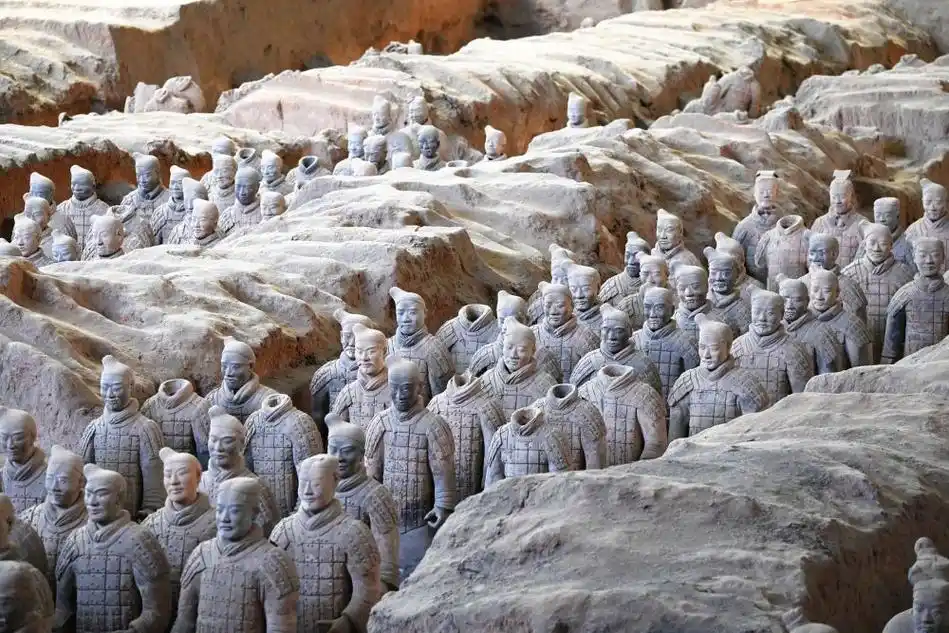
The Terracotta Army is the reason most people come, and it is also the day that catches older visitors out. The site sits about an hour east of the city, and inside it the distances between pits are long, on flat but hard ground, with very little seating. Pit One — the huge one — is where everyone wants to stand, and standing is exactly what there is to do.
Plan it with a wheelchair or a folding stool, or ask the site for the assisted route. The covered halls mean the day works in any weather, which makes it the right anchor for a rainy slot in the itinerary.
The city wall is worth more than the guidebooks say for this audience. You do not have to cycle it — and for most travellers past seventy, you should not. Take the electric shuttle, or simply sit on the wall at a gate tower. The Muslim Quarter below is flat, busy, and one of the best grazing walks in China.

3 to 4 days
Guilin & Yangshuo
If we could prescribe one day in China for an older traveller, it would be the Li River cruise. Four hours on a seat, moving at walking pace through the most recognisable landscape in the country, with tea service and toilets on board. There is no version of a walking day that competes with it.
The one thing to plan is boarding. Some piers require a walk and a set of steps to reach the boat. Tell us in advance and we arrange the pier with the easiest access and staff waiting to help.
Two honest warnings. The Reed Flute Cave is beautiful and involves a long series of wet steps — skip it unless the whole party is steady. The Longji rice terraces are genuinely strenuous at any age; they are not a senior day, and no amount of pacing makes them one. The countryside around Yangshuo by electric cart is the better answer.

2 to 3 days
Shanghai
The most comfortable city in China for reduced mobility, and the one people underestimate. The Bund is completely flat, has railings, benches and a wide promenade, and delivers one of the world’s great skylines from a seated position. The Huangpu River night cruise is the same view from a chair with a hot drink in your hand.
The Shanghai Museum is free, indoors, air-conditioned, fully seated in stretches, and genuinely world-class. It is the best rain-day or heat-day plan in the city and it costs nothing.
Go early to Yu Garden. It is beautiful and it is a maze of steps and narrow passages, and by mid-morning the crowd makes it worse than the architecture. Arrive at opening or leave it out. The maglev train to the airport is a seated, eight-minute, 300 km/h novelty that most people in their seventies enjoy more than they expect to.
What to skip, and the reason
Some of this is counter-intuitive, because the sites named here are the ones most often recommended to first-time visitors. Every one of them is worth seeing. The question is whether it is worth seeing on this trip, at this pace, by this traveller.
| Often recommended | Why it is hard after seventy | What to do instead |
|---|---|---|
| Cycling the Xi’an city wall | A full circuit is roughly 14 km on a stone surface in an upright saddle, with the drop on one side and no shade. | Sit at a gate tower, or take the electric shuttle for a section. Same view, no saddle. |
| The Longji rice terracesGuilin region | Steep, wet, irregular stone steps for hours, with no handrails in stretches and no vehicle access to the viewpoints. | Yangshuo countryside by electric cart, or a longer Li River day. |
| Hiking between Great Wall towers | The restored sections have very steep gradients between towers and uneven footing at the top of each flight. | Ride the cable car to the ridge and walk level along the wall. You still stand on it. |
| Reed Flute CaveGuilin | Long sequences of wet, slick steps in dim light, often with a crowd moving in one direction behind you. | An extra Li River or Yangshuo afternoon; both are flat or seated. |
| Panda base at opening timeChengdu | The enclosures are spread across a hillside, and the early slot that pandas reward is also the one with the most walking and the biggest crowd. | A later, quieter slot with the electric shuttle between enclosures. |
Scroll the table sideways to see every column.
None of this is about avoiding difficulty. It is about spending the difficulty where it earns something. A traveller who skips two strenuous afternoons and spends the energy on the Western Han murals, a private tea tasting, or an unhurried morning in a temple courtyard has a better trip than one who collected the full list and remembers it as a blur of steps.
Medical reality: insurance, medication, and the law behind the ramps
A senior tour is not a tour with a nurse attached. It is a trip planned by someone who has thought about what happens at 2 a.m. if you cannot sleep because you do not have your own medication, and who has already checked that the insurance you bought actually covers the thing you are worried about. This section is the unglamorous one, and it is where the trips that go well are quietly distinguished from the ones that do not.
The legal backdrop: ramps and lifts are not courtesy
China’s approach to accessibility changed decisively in 2023, and it is worth knowing because it explains why a traveller who last visited ten years ago will find a different country. The Barrier-Free Environment Construction Law was passed on 28 June 2023 by the Standing Committee of the National People’s Congress and took effect on 1 September 2023, published as Presidential Order No. 6. It is the first dedicated law China has made on the subject — previously the rules were scattered across disability and elderly-rights legislation and a State Council regulation.
Three parts of it matter to a visitor.
- It is not only for disabled and elderly people. Article 2 states that anyone with a barrier-free need may use barrier-free facilities. That is a wider door than most travellers expect, and it covers the temporary cases as well — the twisted ankle, the recovering knee.
- It is explicitly tied to age-friendly design. Article 4 requires barrier-free construction to be combined with shiláohuá gaizào — retrofitting for older people — under principles of safety and convenience, practicality and ease of use, and broad benefit. This is why a new station in China is likely to have a lift and a ramp rather than a stairway and a handrail.
- It reaches medication labelling. Pharmaceutical producers are required to supply accessible-format labels and instructions in audio, large print, Braille or electronic form. For a traveller managing several prescriptions in a country where the pharmacy staff may not read English, this is a genuine improvement — ask your hotel to help you check the large-print or electronic version against your own list.
The honest limit is age. The law mandates standards for newly built and newly renovated public buildings; it does not retrofit every courtyard, temple stairway or village guesthouse. Sites built before 2023 vary enormously, and a heritage site will always involve compromises with the original structure. What has changed is the direction of travel, and the existence of a lift where there previously was none.
Insurance: the three clauses that decide whether you are covered
We do not sell insurance and this page will not recommend a policy, because the right one depends on your nationality, your medical history and the length of the trip. But there are three things worth checking in writing before you book anything else, and the failure of any one of them is the reason most senior travel-insurance disputes happen.
- The upper age limit. Many travel medical policies stop accepting new applicants at some age between sixty-five and eighty, and a few reduce cover as you pass age bands rather than excluding you outright. Find the sentence that names the limit in your own policy. If a broker tells you there is no limit, ask for it in writing.
- Pre-existing conditions. These are usually excluded unless declared and specifically accepted. Age itself is not a pre-existing condition, but almost everything that happens to a seventy-five-year-old in a foreign country is at least adjacent to one. Declare the conditions and pay the loading if there is one.
- Evacuation and repatriation cover. This is the clause that matters most and costs least attention. A medical evacuation from a remote region, or repatriation of remains, is where the five-figure bills live. Check that your cover includes both, and check the limit, not just the existence.
One structural caveat. A policy issued in your home country is normally what you want, because it pays according to rules you understand and in a currency you understand. Chinese hospitals commonly expect payment at the time of treatment for foreign patients, and international departments at large hospitals are set up for card payment. We can arrange a translator for a hospital visit, but we cannot make an insurer pay.
Medication: the single most common avoidable problem
Travellers run out of medication, or lose it, or discover that the brand name means nothing in a Chinese pharmacy. All three are avoidable. The routine that works is short.
| Do this | Because |
|---|---|
| Carry the full trip’s supply in hand luggage, in the original packaging with the pharmacy label intact. | Checked bags go missing. Original packaging is what customs reads, and loose pills in a weekly organiser cannot be identified. |
| Bring a letter from your doctor stating the condition, the drug, the dose and that it is for your personal use. | It answers the only question a customs officer has. A prescription alone may not name the condition, and the officer may not read the language it is written in. |
| Write down generic names, not brand names. | Brand names differ by country, and a Chinese pharmacist will recognise the generic name or the chemical name far more reliably. |
| Photograph every prescription and every label, and keep the photos offline as well as on the phone. | If a bag is lost, the photographs are what lets a doctor in China continue your treatment rather than guess at it. |
| Split the supply across two bags. | It halves the damage of one lost bag, and it keeps a few days’ doses with you if the rest is delayed with the luggage. |
| Check any controlled substance in advance. | Some medicines that are ordinary at home are restricted or regulated in China. If anything on your list is a controlled drug, tell us before you book, not at the airport. |
Scroll the table sideways to see every column.
Altitude, and the one place where age becomes a document
For most of China there is no maximum age and no health certificate. High-altitude routes are the exception, and Tibet is the clearest case: from a certain age, operators ask for documentation, and the requirements step up as you get older — a signed responsibility letter at the lower rung, a hospital health certificate confirming fitness for high altitude at the next, a full examination report plus a named companion above that, and a point beyond which tours are generally not accepted at all.
The important qualification is that these thresholds are set by the operator handling your permit, not by a single national rule, and they differ between operators. We have seen published ladders that start the health certificate at sixty-five and others that start it at sixty. If a high-altitude route is part of your plan, that is a conversation to have at the enquiry stage, months out — not once flights are booked.
We keep the full age-by-age ladder, the documents and the companion rules on a dedicated page, and we would rather you read it there than take a summary from here: high-altitude and Tibet tour arrangements. Kailash, for its part, applies a stricter rule again.
Below the high plateau, altitude is not a mainstream concern on this itinerary. Xian sits around 400 metres, Beijing around 44, Shanghai at sea level, and Guilin around 150. None of them will be felt.
The document checklists
Everything above, reduced to a list you can print and pack. Turn on the two switches that apply to you and the list builds itself. The eleven items that are always required are on from the start.
Build your checklist
Print it, or photograph the screen. Nothing here is collected or sent anywhere — the list is built in your browser and disappears when you close the page.
- PassportValid six months beyond your return date, with blank pages for the entry and exit stamps.
- Visa, or proof of visa-free eligibilityConfirm the current policy for your nationality before you book flights. The rules have changed several times recently and third-party summaries lag behind them.
- Travel medical insuranceCheck the upper age limit, the pre-existing-condition terms and the evacuation limit, in writing.
- Medication listGeneric names and doses for every drug, plus your prescribing doctor’s name and contact.
- Doctor’s letter for medicationNaming the condition, the drug and the dose, and stating that it is for personal use.
- A full supply of medicationIn original packaging, in hand luggage, split across two bags.
- Photographs of every prescription and labelStored offline as well as on the phone.
- Hotel confirmations with the address in ChineseA driver cannot act on a Latin-script address. Keep the Chinese text on paper as well as on the phone.
- Itinerary with guide and vehicle detailsIncluding one emergency contact number for each city on the route.
- Evacuation cover confirmationA note of the limit and the policy number, kept somewhere other than the bag it covers.
- Routine vaccinations up to dateCheck with your doctor whether any destination-specific advice applies to you.
- Wheelchair or walking-aid bookingBook with each airline separately; a booking made on one carrier does not travel to the other.
- Rail assistance booked on 12306At least six hours before departure, and one request per leg if the journey changes trains.
- Cabin or accessible room requestLow floor, grab rails by the bath and toilet, and a step-free shower rather than a bath with a screen.
- Altitude fitness letterRequired on some high-altitude routes from sixty-five, and by some operators from sixty.
- Companion arrangementSome routes above a certain age require a named companion on the booking, so it cannot be arranged late.
What a senior itinerary costs, in two numbers rather than one
A single price on a page like this is either a marketing figure or a lie, and often both. What is genuinely useful is the range the operator publishes and an honest account of what moves you from the bottom of it to the top. So here are both, and the numbers come from this operator’s own published tour pages rather than from an industry average nobody can check.
| Published ten-day itinerary | Format | Range, per person | What the range contains |
|---|---|---|---|
| Classic ChinaBeijing, Xi’an, Guilin, Shanghai | Private | US$2,000 – 10,000 | A dedicated vehicle and guide throughout, hotels from four-star to five-star, internal transport, and the pacing adjustments described on this page. |
| The same ten-day routeSame cities, shared departure | Small group | US$1,480 – 7,400 | A fixed departure with a small number of other travellers. Lower entry price, less freedom over start times and rest stops. |
| Bullet train ChinaPandas, Terracotta Army, Beijing, Shanghai | Private | US$2,000 – 10,000 | Rail rather than domestic flights between cities, which for a traveller with reduced mobility is often the better day as well as the cheaper one. |
Scroll the table sideways to see every column.
The gap between the first two rows is worth looking at directly. The small-group version of the identical ten-day route starts at US$1,480 against US$2,000 private — roughly 26 per cent lower at the entry point, and lower again at the top of the range. That difference is not a discount for worse travel. It is the cost of exclusivity, and for some senior travellers it is the wrong thing to pay for: a small group has fixed start times and fixed rest stops, and the whole point of this page is that those are exactly what you want to control.
What moves you up the range
| Lever | What changes |
|---|---|
| Private rather than small groupThe largest single lever | Roughly a quarter on the entry price, and considerably more at the top of the range. |
| Hotel class and location | Compounds nightly across the whole trip. A centrally located four-star is usually a better senior choice than a distant five-star, because it removes vehicle time from every day. |
| Season | Public holidays and the summer school break cost more and are more crowded. June and September are the better trade on both counts. |
| Internal transport | High-speed rail against a domestic flight. Rail is often cheaper and always easier to move through. |
| Number of cities | Every added city adds a hotel and a transport leg. This is why the gentler pace tiers usually cost less rather than more. |
| Support arrangements | Wheelchair provision, a nurse or companion, and step-free room guarantees are priced per trip and should be quoted as line items, not absorbed into a vague total. |
Scroll the table sideways to see every column.
Reading these numbers correctly
- They are the operator’s published ranges for ten-day itineraries, per person, taken from the tour pages themselves. They are planning bands, not a quotation.
- They are not a senior surcharge. There is no senior supplement on these tours; a gentler pace usually costs less, because it involves fewer cities and fewer internal legs.
- The real figure depends on your dates, your party size and your hotel tier. Two people travelling in September have a different number from four people travelling in May, on the same itinerary.
- Anything a quote does not itemise, ask to have itemised. Wheelchair provision, a nurse and guaranteed step-free rooms should appear as lines, not as a rounded-up total.
Booking, and what to send us
The more we know before we design the itinerary, the fewer compromises you make on the ground. Send these seven things and the first draft will usually be close enough that the second is a set of adjustments rather than a rewrite.
- The ages of everyone travelling. Not for a discount calculation — for the pace tier, and for the high-altitude paperwork if it applies.
- Your pace tier, from the self-assessment above, or a sentence describing a typical day you have enjoyed recently.
- Any mobility constraint, including a walking aid, a wheelchair, a recent joint replacement, or a preference for avoiding stairs.
- Medical constraints we should plan around, in as much or as little detail as you are comfortable giving. A stable heart condition changes which wall section we choose; it does not stop the trip.
- The cities you care about, and the ones you are happy to drop. Two nights in three cities is a far better senior trip than one night in six.
- Your dates and the season, including any fixed commitment such as a flight or a family event.
- Hotel preference — class, and more importantly whether you would rather be central in a simpler hotel or out of the centre in a grander one. For most travellers on this page the answer is central.
What you get back is a day-by-day plan that shows the walking distance and the vehicle time for each day, so you can approve it against what you actually want to do rather than against a list of place names. If a day looks too full, say so — that is precisely the conversation this page exists to make possible.
Frequently asked
There is no national maximum age for visiting China, and no health certificate is required for a standard tourist itinerary. The exception is high-altitude travel, where the operator handling your permit sets documentation requirements that step up as you get older — and those thresholds differ between operators rather than following one published national rule.
Sometimes, and it depends on the site. Beijing’s Temple of Heaven and Summer Palace both extend free admission at sixty to foreign visitors, and the Summer Palace answer comes from the municipal parks authority on an official English channel, naming a passport explicitly. The Palace Museum’s published clause grants half price to a holder of a valid identity card and does not name a passport, so treat that one as unconfirmed and ask at the desk.
No. The Palace Museum gives half price from sixty, not free entry: CNY 30 instead of 60 in peak season, CNY 20 instead of 40 off-peak, and CNY 5 instead of 10 for each of the two gallery tickets. Note also that the museum does not sell same-day tickets at all — presale opens at 20:00 seven days before your visit date.
Yes, and it is free. China Railway runs a priority-passenger assistance service with five categories, including unaccompanied older passengers — generally over sixty-five, travelling alone and with limited mobility. It covers assisted entry and exit, priority security and boarding, physical help getting on and off the train, a free wheelchair or stretcher inside the station, and follow-up attention on board.
At least six hours before departure if you book online, through the 12306 website, app or hotline. At the station itself the deadline is sixty minutes before departure, at the 12306 service desk or comprehensive service centre. If your journey involves changing trains, each leg needs its own request.
For most travellers past seventy, three consecutive full days before a rest day is the shape that holds up best. A well-built senior itinerary puts the rest day in the middle rather than at the end, because a rest day after the fatigue has accumulated is recovery rather than prevention. The self-assessment tool on this page places you in one of three tiers with the daily walking and vehicle numbers that follow.
Not for an ordinary tourist itinerary, at any age. Documentation starts to appear on high-altitude routes, where a signed responsibility letter, a hospital health certificate confirming fitness for altitude, or a full examination report may be requested depending on age and on the operator. Confirm the requirement with your operator at the enquiry stage, well before flights are booked.
That depends entirely on the policy, and it is worth checking three specific clauses rather than assuming. Look for the upper age limit for new applicants, the treatment of pre-existing conditions, and the evacuation and repatriation limit. Ask for the age clause in writing if a broker tells you there is no limit. We do not sell insurance and cannot recommend a policy, because the right one depends on your nationality and medical history.
Yes, with planning. The Barrier-Free Environment Construction Law, in force since September 2023, sets accessibility standards for newly built and newly renovated public buildings, and stations commonly have lifts and ramps. Heritage sites built long before that vary considerably, and some courtyards and temple stairways remain difficult. Wheelchair provision is available at railway stations free of charge for getting to the train, and cabin wheelchair bookings must be made with each airline separately.
The published ten-day private itineraries on this site run from US$2,000 to US$10,000 per person, and the same route as a small-group departure starts at US$1,480. There is no senior supplement. The gentler pace tiers tend to cost less rather than more, because they use fewer cities and fewer internal transport legs. The final figure depends on your dates, party size and hotel tier.
Sources, and the limits of this page
Every figure on this page was taken from a named primary source on the date checked. Where a claim could not be verified against a first party, it is marked as unconfirmed rather than presented as fact — the Palace Museum senior discount for passport holders is the clearest example, and we would rather tell you to ask at the desk than tell you a number we cannot stand behind.
- Barrier-Free Environment Construction Law of the People’s Republic of ChinaPassed 28 June 2023 by the Standing Committee of the 14th National People’s Congress; in force 1 September 2023; eight chapters. Policy briefings and the full text published by the State Council (gov.cn) and the National People’s Congress (npc.gov.cn), August 2023.
- Presidential Order No. 6Promulgation of the above law, State Council, 28 June 2023.
- Palace Museum ticket policyOfficial ticket pages at ticket.dpm.org.cn and young.dpm.org.cn. Seasonal pricing, the 60-plus half-price clause, gallery prices, the no-same-day-ticket rule and the 20:00 seven-day presale window.
- China Railway priority passenger assistanceOfficial notice at kyfw.12306.cn, describing the five service categories, the 65-plus unaccompanied older passenger definition, the six-hour and sixty-minute deadlines, and the services provided.
- China Railway priority passenger booking rulesmobile.12306.cn, covering online submission, the documentation check, and the requirement to book each connecting leg separately.
- State Council reply on services for older rail passengersgov.cn, 2 April 2026, from the China State Railway Group passenger transport department. Telephone booking from 60, priority lower-berth allocation, the staffed gate channel, and the 65-plus assistance threshold.
- Temple of Heaven free admission for foreign visitorsCCTV culture-travel reporting, 26 March 2024, quoting park staff confirming that the 60-plus free-entry policy covers foreign visitors presenting a passport.
- Temple of Heaven ticketing in EnglishHaibao News report, 28 June 2024, on the bilingual ticket platform, English service window and the 60-plus policy applied to foreign visitors.
- Summer Palace admission for a foreign visitor aged 60-plusEnglish-language answer published by the Beijing municipal government’s 12345 service desk, 25 September 2025, from the Beijing Municipal Administration Center of Parks. Names passport or permanent residence card as acceptable identity at the verification lane. Park hotline +86-10-62881144, English service 08:30 to 17:00.
- Published tour pricesThe AggregateOffer price data on this operator’s own product pages for the ten-day Classic China, small-group and bullet-train itineraries, read on the date checked. These are the operator’s published planning ranges.
- PhotographyImages on this page are this operator’s own photographs, hosted on this domain.
What this page does not claim
- It is not medical advice, and nothing here decides whether you are fit to travel. That is a conversation with a doctor who has examined you.
- The discounts listed are the published policies of named sites on the date checked. They change without notice, and a foreign passport is not accepted at every ticket office.
- The price ranges are planning bands taken from this operator’s published tour pages, not a quotation for your trip.
- Age thresholds on high-altitude routes are set by the operator handling your permit, and they differ between operators. Confirm yours at the enquiry stage.
- We have no relationship with the parks, museums or railway services described, and quoting their published policies is not an endorsement by them.
The pages that go deeper
China at the pace you actually want to travel it
Send us the ages, the pace tier from the tool above, and anything we should plan around. You get back a day-by-day itinerary with the walking distance and vehicle time shown for every day, so you can see exactly what you are agreeing to before you agree to it.
Start with
The pace tier
Gentle, steady or active. It decides the cities, the days and the hotel locations before anything is booked.
Then
The two checklists
Documents and medication, printed and packed. This is the part that prevents the avoidable problems.
Finally
The two bookings
Rail assistance at least six hours ahead, and insurance clauses confirmed in writing.
Tell us who is travelling and how you like to travel.
Plan a senior-friendly itinerary A first draft usually comes back within a day, with the pacing worked out and the hard days either redesigned or replaced.