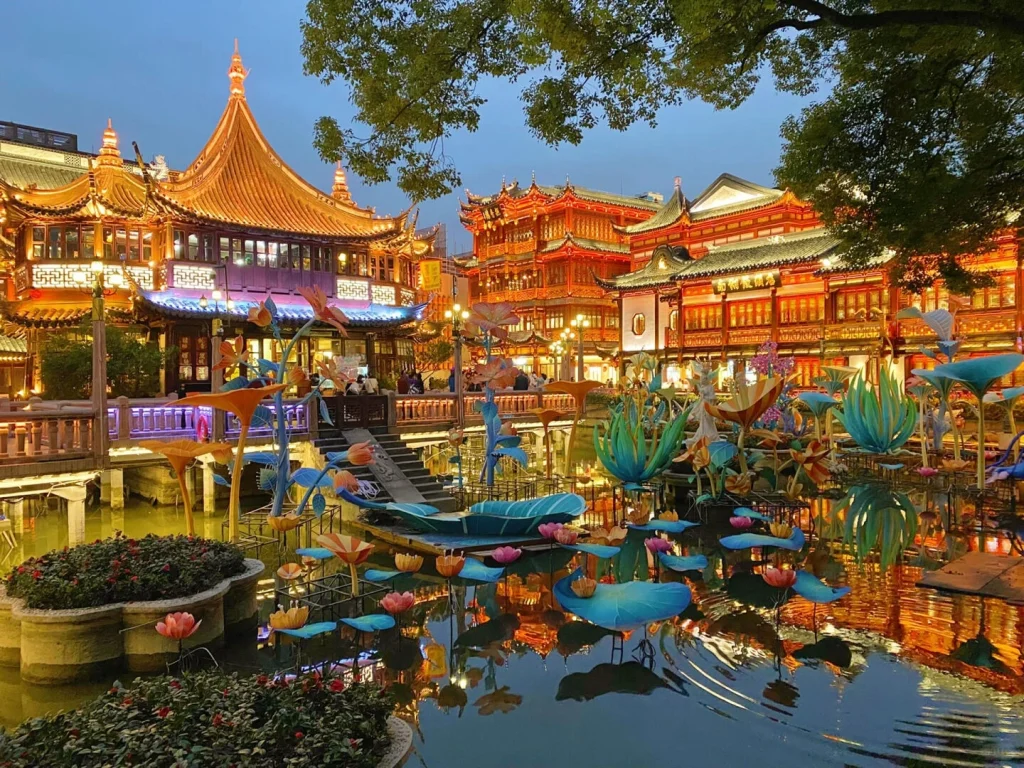
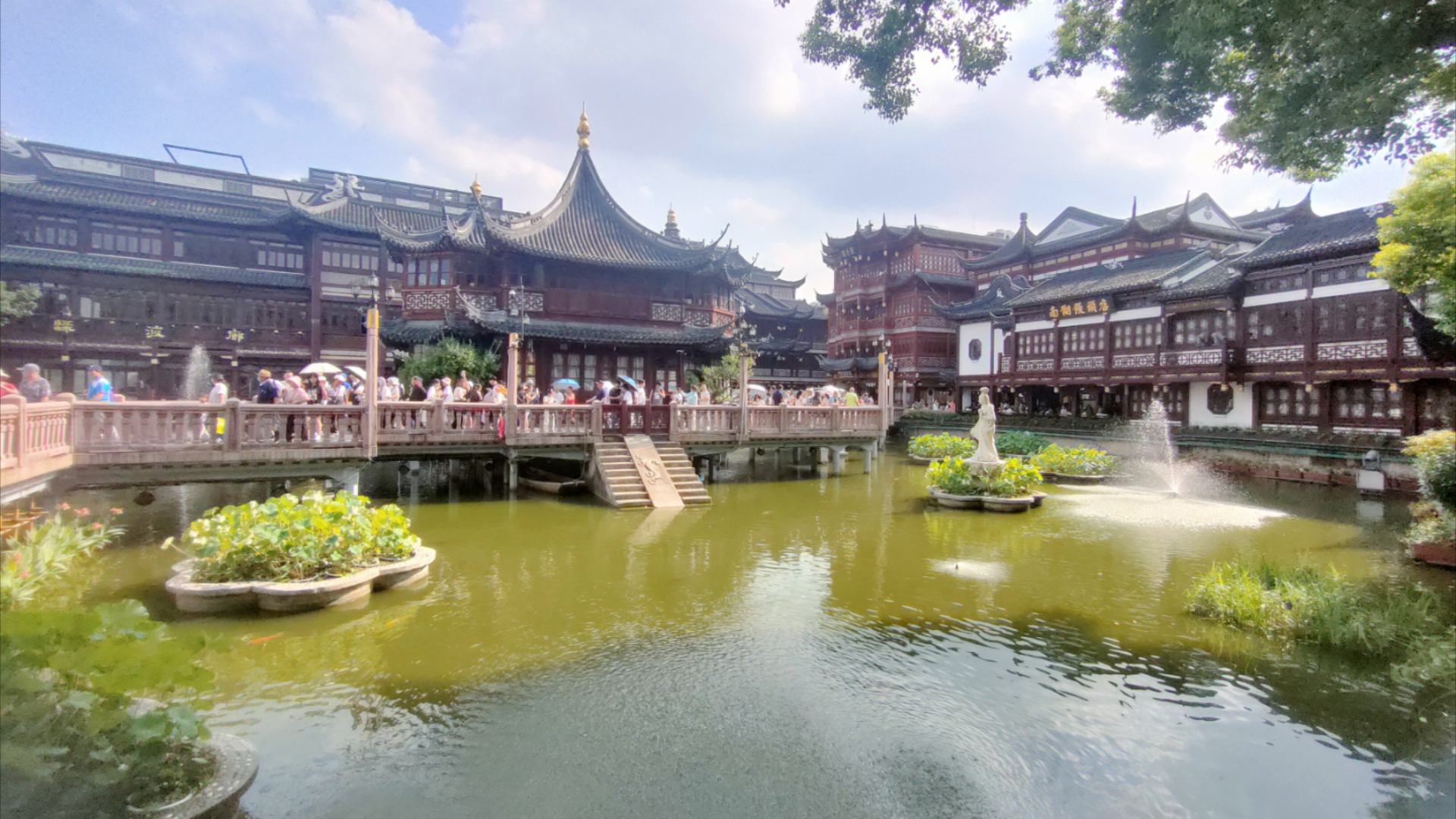
Your guide meets you at the zigzag bridge — the Nine-Turn Bridge leading to the Huxinting Tea House, sitting in a lotus pond since 1784. Through the garden gates, Shanghai's skyscrapers disappear. Rockeries rise like miniature mountains, placed by the garden's creator to remind his aging parents of landscapes they could no longer travel to see. Carp flash orange in hidden ponds. Dragons coil across white walls, their ceramic scales glinting. Your guide reveals why the garden took 18 years to build, which pavilion was built for a general's mother who never learned to read, and how this private paradise survived centuries of war and revolution.
Yu Garden isn't just a beautiful space — it was built by a son for his aging parents, every rock and pavilion a gesture of love. Your private guide brings this 450-year-old story to life.
"Every stone in Yu Garden was chosen for a reason. The garden's creator, Pan Yunduan, was a Ming Dynasty official who built this paradise for his aging parents. The rockeries are miniature mountains — so his father, too frail to travel, could still experience China's landscapes. The zigzag bridges force you to slow down and appreciate each view. The garden took 18 years and bankrupted the family." — Your Yu Garden guide
The centerpiece of Yu Garden is the Grand Rockery — a 14-meter-high mountain of yellow stones, stacked without mortar to create peaks, caves, and waterfalls. It's the largest and oldest rockery in southern China. Your guide walks you up the winding paths to the pavilion at the top, where you see all of Yu Garden spread below — and beyond the walls, the Pudong skyline, old and new Shanghai coexisting.
Throughout Yu Garden, five dragon walls coil across whitewashed surfaces. The most famous is the two-dragon wall — two ceramic dragons facing each other, a pearl between them, scales individually fired and glazed. Your guide explains the dragon symbolism (imperial power, protection, rain) and points out details most visitors miss: the fifth claw marking an imperial dragon, the bat under one chin (a pun for good fortune).
Yu Garden sits inside Shanghai's Old City — the original walled settlement centuries before the Bund. Your guide walks you through the City God Temple (Chenghuang Miao) where locals still burn incense, the narrow lanes of the old Chinese city, and the bustling bazaar for soup dumplings and street food. The contrast between the garden's serenity and the bazaar's chaos is pure Shanghai.
Yu Garden reveals itself through carefully framed views — a pavilion through a moon gate, a dragon wall reflected in a carp pond, a tea house floating on still water.
"Yu Garden opens at 8:30am and is nearly empty for the first hour. By 10am, tour groups arrive. Your guide brings you at opening time — you'll have the rockeries and pavilions almost to yourself, with perfect morning light through the moon gates."
"The Huxinting Tea House has been serving tea since 1784. Queen Elizabeth II visited. Your guide reserves a window table where you can watch the lotus pond while sipping Dragon Well tea."
"From the pavilion atop the Grand Rockery, you can photograph Yu Garden's rooftops against the Pudong skyline — a perfect Shanghai-in-one-frame shot. Your guide knows the exact angle. Morning light (8:30–9:30am) is best."
"Yu Garden and the Bund are 10 minutes apart but separated by 400 years. Morning at Yu Garden for Ming Dynasty serenity, then the Bund for colonial grandeur and Pudong skyline. The classic Shanghai one-day itinerary."
"If traveling with children, ask your guide about feeding the koi. Some carp are over 60 years old and enormous. Your guide buys the fish food from the garden shop."
"The Yu Garden Bazaar outside the gates is a maze of food stalls and shops. Your guide knows which stall has the best soup dumplings (the one with the longest line of locals) and which tea shop doesn't overcharge tourists."
Travelers who discovered Yu Garden with a private guide.
"Yu Garden was our first stop in Shanghai and it completely reset my expectations. One minute you're in a modern city, the next you're in a 450-year-old Ming Dynasty garden where every rock tells a story. Our guide explained the builder created it for his aging parents — every rockery is a miniature mountain. Standing in the pavilion where his mother spent her afternoons hits differently when you know that."
"The Huxinting Tea House on the zigzag bridge was worth the trip alone. Queen Elizabeth visited. Bill Clinton visited. Now I've had tea there too, watching lotus flowers drift past the window. Our guide reserved the best table. The vegetarian dumplings were some of the best I've had — and I've eaten a lot of dumplings in China."
"As someone who designs gardens professionally, Yu Garden was a pilgrimage. The Grand Rockery alone — 14 meters of yellow stones stacked without mortar, creating peaks, caves, and waterfalls — took my breath away. Our guide knew which stones came from 2,000 kilometers away and why each was chosen. Five dragon walls, each unique. I took over 300 photos."
"Traveling with our 7-year-old, I worried Yu Garden might be boring for her. I was wrong. The koi feeding was a highlight — the fish are enormous and our guide bought the food and showed her how to toss it. The zigzag bridges (she ran across them 20 times), the dragon walls, the tea ceremony... she still talks about the garden a month later. Best family activity in Shanghai."
Tell us your travel dates. We'll arrange your private Yu Garden guide, tea at the Huxinting Tea House, and a walk through the surrounding Old City. Optional extension to the Bund. Free itinerary draft within 24 hours.
