Your guide meets you at the entrance gate inscribed with calligraphy from a Qing Dynasty emperor. You walk through the first courtyard and the noise of modern Chengdu vanishes, replaced by the scent of old wood incense and the whisper of cypress trees planted centuries ago. Your guide stops before a stele carved in 809 AD — the "Three Successive Reigns Stele," so famous that Chinese schoolchildren study its text. She points out a line written by a Tang prime minister, then translates the poem praising Zhuge Liang carved beside it. This is not a museum tour. This is China's soul, set in stone.
Your private guide is a historian who peels back 1,800 years of legend to reveal the real Zhuge Liang — strategist, inventor, statesman, and the most beloved figure in Chinese history.
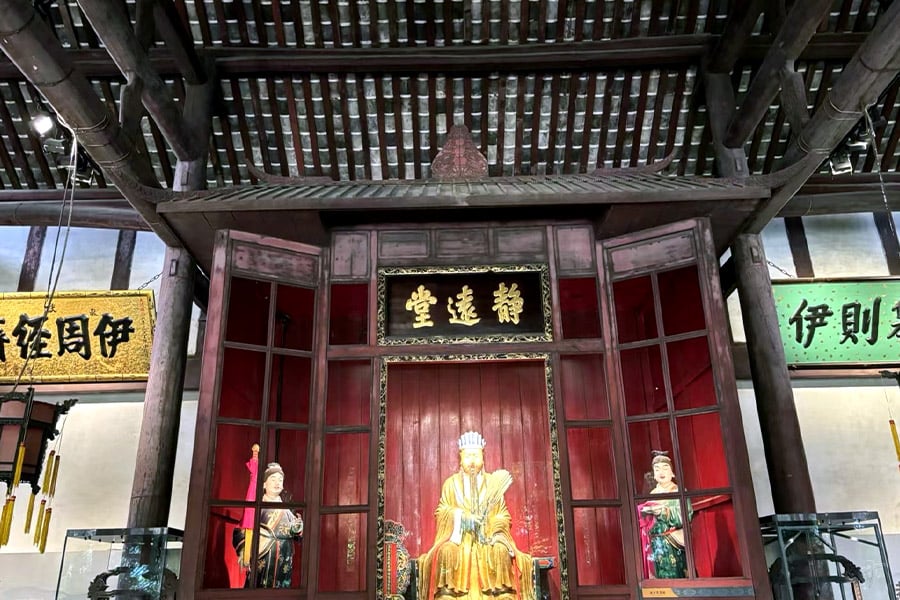
"Every Chinese child knows Zhuge Liang. But the real man was more remarkable than the legend. He didn't just plan battles — he invented the repeating crossbow, designed an automated mechanical transport called the wooden ox, wrote philosophical essays still studied in universities, and governed a kingdom with such integrity that his enemies respected him. I'll show you the hall where his statue sits — flanked by his son and grandson, who both died defending Shu Han. Three generations sacrificed everything." — Your historian guide
Behind the main hall, a massive circular earthen mound rises 12 meters high under a canopy of ancient trees. This is the tomb of Liu Bei, founder of Shu Han — a ruler so beloved that when he fled an invading army, thousands of civilians followed him rather than live under the conqueror. Your guide explains the unusual layout: the emperor's tomb sits behind his minister's shrine, a deliberate architectural choice suggesting that even the emperor deferred to Zhuge Liang's wisdom.
"This corridor is a library carved in stone. The 'Three Successive Reigns Stele' from 809 AD — Tang Dynasty prime minister Pei Du wrote the text, master calligrapher Liu Gongchuo carved it, and it commemorates Zhuge Liang. Chinese historians call it the 'Three Excellences Stele': excellent writing, excellent calligraphy, excellent subject. Your guide reads key passages aloud in Chinese, then translates — the poetry is devastatingly beautiful."
Tucked behind the main temple complex, a hidden garden holds centuries-old miniature landscapes. Szechuan pepper trees trained for 200 years into perfect cascading forms. A rock representing Mount Emei with tiny moss forests. Your guide shows you the oldest bonsai — a cypress in training since the Ming Dynasty — and explains how Sichuan's unique climate produced a bonsai tradition entirely different from Japan's. Most visitors miss this garden completely.
The red corridors, stone steles, and ancient cypress gardens of China's most famous Three Kingdoms memorial.

"I bring guests after lunch — 2pm to 5pm. Morning tour groups crowd the main halls. Afternoons are quieter, and the light through the cypress trees at 4pm turns the red corridor into a photographer's dream. The temple is most atmospheric in the last hour before closing when the incense smoke catches the low sun."
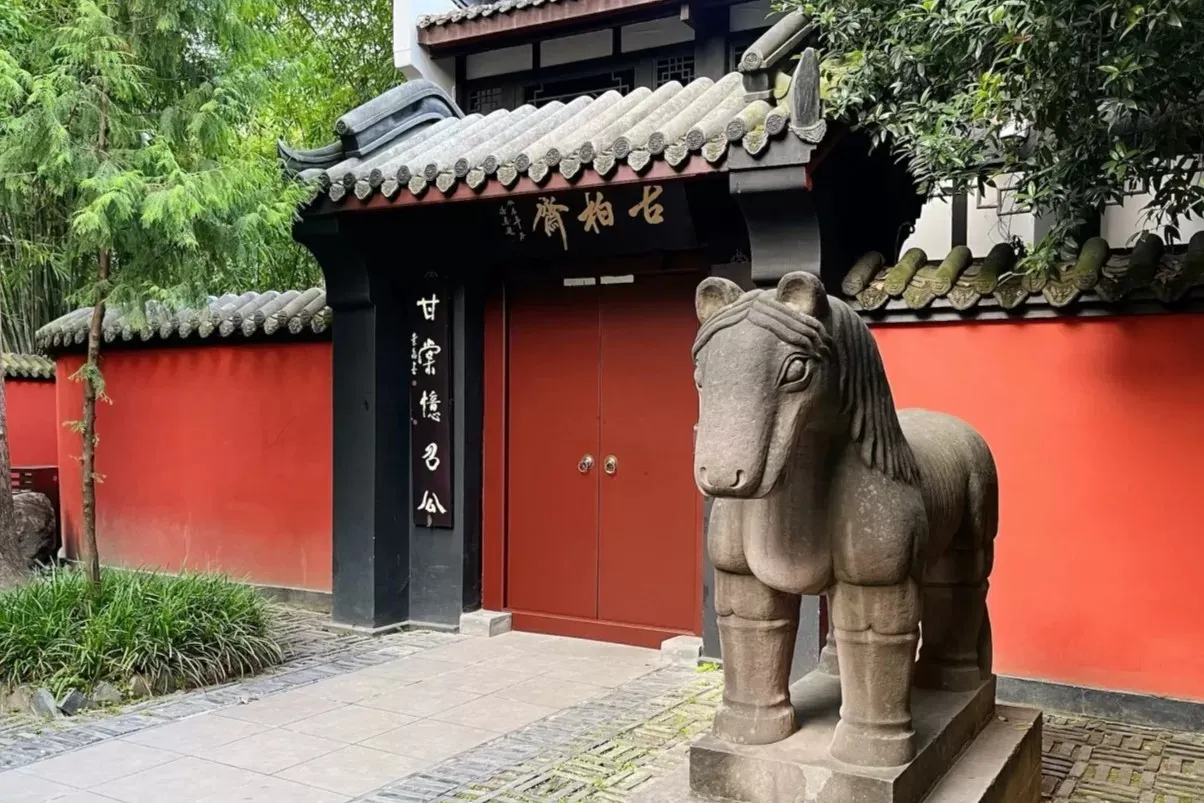
"Above the main gate is a couplet that Chinese historians consider the finest summary of Zhuge Liang's legacy. The first line praises his military genius; the second mourns his unfulfilled dream of reunifying China. Every Chinese visitor pauses here. Without a guide, you'd walk under it without knowing you missed the heart of the entire shrine."
"The shrine's east gate opens onto Jinli Ancient Street. I time the visit so my guests exit at dusk — temple incense still in their clothes, Three Kingdoms stories in their heads — and step directly into the lantern-lit food stalls and tea houses of Jinli. It's the most dramatic contrast in Chengdu: solemn history to vibrant street life in five steps."
"Every statue of Zhuge Liang shows him holding a crane-feather fan. This wasn't just for cooling — it was his trademark in battle. He would stand on the front line, fanning himself calmly while arrows flew, to show his troops he was unafraid. The fan became the symbol of strategic genius in Chinese culture. Your guide tells this story standing before the hall where his 1,800-year-old statue still holds that fan."
Travelers who discovered the Three Kingdoms with a private historian guide.
I'm a history teacher and I was absolutely blown away. Our guide was essentially a Three Kingdoms scholar — she pointed out details I would have researched for months and still missed. The 809 AD stele, the couplet above the main gate, the political symbolism of Liu Bei's tomb placement behind Zhuge Liang's shrine. Three hours flew by. Then we stepped through the east gate into Jinli for dinner. Best afternoon in Chengdu, hands down.
Before this visit, I vaguely knew Zhuge Liang from the Dynasty Warriors video games. After three hours with our guide, I understand why an entire civilization has mourned this man for 1,800 years. The red corridor photos were spectacular, but what I'll remember is standing before Liu Bei's tomb while our guide explained why thousands of civilians chose to follow a defeated emperor rather than stay in their homes. History came alive.
As a Chinese-American visiting my ancestral homeland, Wuhou Shrine was deeply personal. Our guide recognized this immediately and tailored the tour — she focused on the Chinese diaspora's connection to these stories, read the Tang poems aloud so I could hear the classical Chinese pronunciation, and showed me the character for 'loyalty' on the oldest stele. I cried at Liu Bei's tomb. She gave me space, then quietly told me the story of his final words to Zhuge Liang. A masterclass in guiding.
My wife was skeptical — 'another temple?' She's now planning a Three Kingdoms-themed book club because of this visit. Our guide had this incredible talent for connecting ancient history to modern life: how Zhuge Liang's management philosophy is taught in Chinese business schools, why the 'Empty City Strategy' is still used as a metaphor in corporate negotiations. We did the shrine, then Jinli for dinner, and it was the single best day of our two-week China trip.
Tell us your travel dates. We'll arrange your private historian guide, handle temple tickets, and time your visit for the perfect afternoon light — with Jinli Ancient Street awaiting you at dusk. Free itinerary draft within 24 hours.
