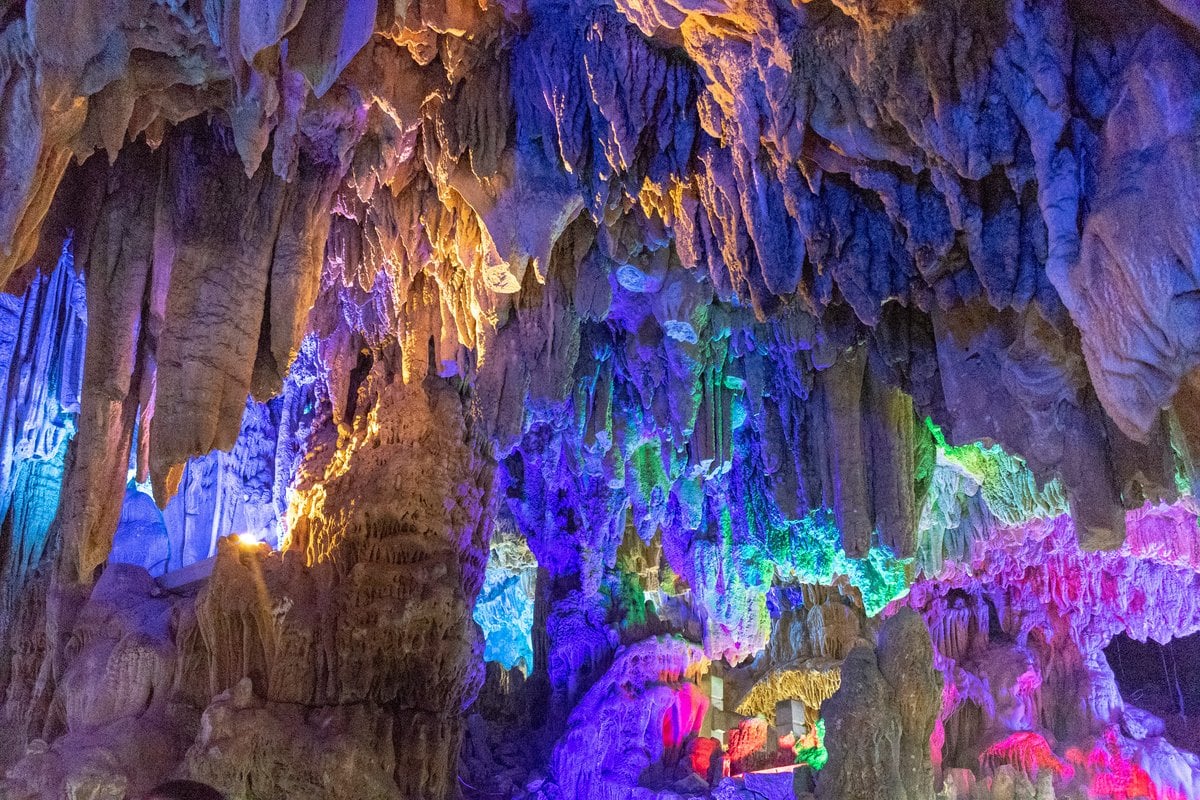
Your guide meets you at the cave entrance — a modest opening in the karst hillside that gives no hint of what lies beneath. You descend into a vast chamber where water has been sculpting limestone for 180 million years. Stalactites hang like frozen waterfalls. Stalagmites rise from the floor like stone forests. Your guide points to formations with names that have been passed down for centuries: the Crystal Palace, the Dragon Pagoda, the Virgin Forest of stone columns. But the real stories are the ones the audio guide doesn't tell: how local families hid in this cave during WWII, the 1,200-year-old Tang Dynasty ink inscriptions still visible on the walls, and which rock formation looks exactly like Elephant Trunk Hill — connecting the underground world to the Guilin landscape above.
The audio guide gives you formation names. A private guide gives you the stories: where families hid during wartime, which Tang Dynasty poet left his mark, and how this underground world connects to the karst landscape above.
"The main chamber of Reed Flute Cave — named the Crystal Palace — could hold a thousand people. During World War II, it did. Local families fled here when Japanese bombers flew over Guilin, hiding in the darkness while the war raged above. Your guide shows you the natural alcoves where families slept, the chamber where a field hospital was set up, and the entrance they sealed with bamboo screens. The formations are beautiful. The history makes them meaningful." — Your Reed Flute Cave guide
"On the cave walls, barely visible in the dim light, are ink inscriptions written during the Tang Dynasty (618-907 AD). Buddhist monks and travelers left poems and travelogues using lampblack ink. 'I came here seeking solitude and found a palace underground' reads one. Your guide knows where to shine the flashlight to reveal these ancient messages — words written when Europe was in the Dark Ages." — Your Reed Flute Cave guide
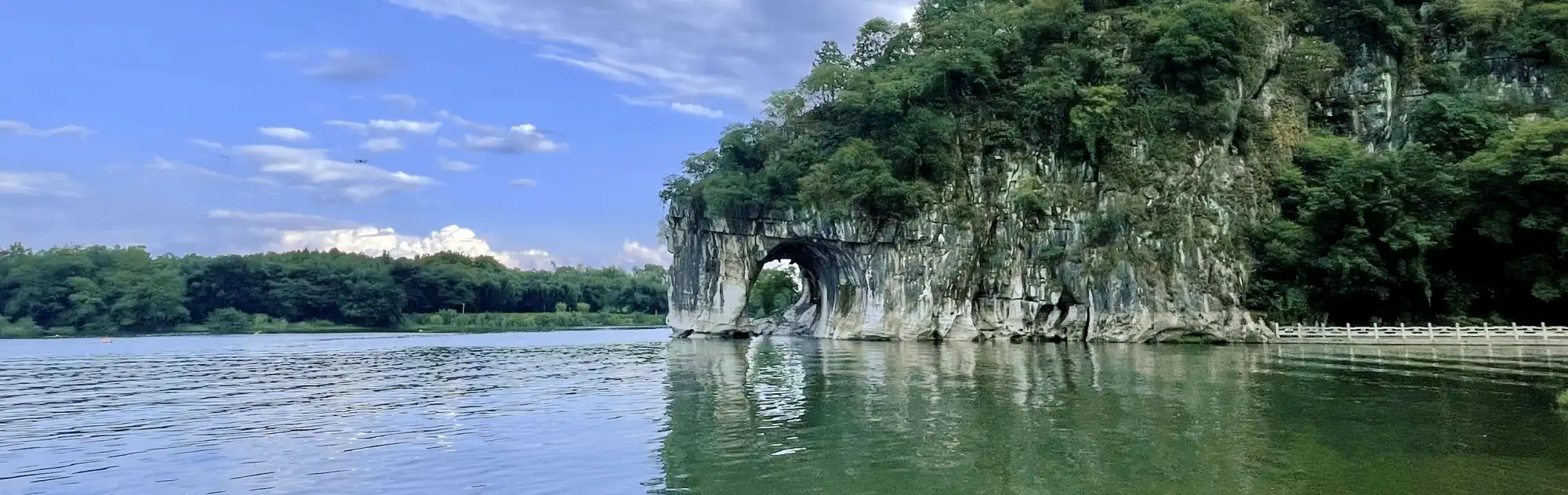
"One of the most magical realizations inside Reed Flute Cave is that the formations echo the landscape above. A cluster of stalagmites forms the exact silhouette of Elephant Trunk Hill. A flowstone cascade mirrors the karst peaks along the Li River. Your guide shows you the connections: the same limestone, the same water, the same geological forces — one above ground, one below — creating parallel worlds over 180 million years." — Your Reed Flute Cave guide
"The cave's colored lighting is designed for atmosphere, not photography. Your guide knows which formations look best under which lights, where to stand to avoid the red/green color casts, and how to use your phone's night mode for surprisingly good results. For serious photographers, your guide can arrange a private visit before opening hours when the standard lighting sequence is paused and you can work with natural spotlighting." — Your Reed Flute Cave guide
Reed Flute Cave in three acts — the vast Crystal Palace chamber, the Dragon Pagoda formation, and the Virgin Forest of stone columns reaching toward the cave ceiling.
"Reed Flute Cave is Guilin's most popular attraction. By 10am, the walkways are crowded and the audio guides create a wall of competing sound. Your guide brings you at 8:30am — you enter as the cave opens, the lights are fresh, and you have the formations almost to yourself. You're done before the first tour bus unloads."
"The cave interior is humid year-round with water dripping from the ceiling. The paved walkways can be slippery. Wear shoes with good grip — no flip-flops or smooth-soled dress shoes. Your guide walks at a comfortable pace and knows which sections are driest."
"The colored lighting makes photography tricky but not impossible. Your guide shows you the best phone technique: night mode on, brace your elbows against a railing, and wait for the blue/white light sequence (avoid the red/green phases). The best shot in the cave: the reflection of the Crystal Palace formations in the shallow pool at the chamber's center — a perfect mirror image."
"Reed Flute Cave takes about 90 minutes. Elephant Trunk Hill is 15 minutes away by car. Your guide schedules both for the same morning: Reed Flute Cave at 8:30am (before crowds), Elephant Trunk Hill at 10:30am (best light on the elephant formation). Two of Guilin's icons, one efficient morning."
"Most visitors walk right past the Tang Dynasty inscriptions without noticing them — the lighting doesn't highlight them and the audio guide barely mentions them. Your guide knows exactly where to find the 72 surviving inscriptions (of an original 100+). The oldest is from 792 AD, written in a beautiful calligraphic hand. Ask specifically to see them — it's the most overlooked treasure in the cave."
"Reed Flute Cave is in the northwest of Guilin, and your guide knows the best Guilin mifen (rice noodle) shop nearby — a no-sign, hole-in-the-wall that's been run by the same family for 40 years. A steaming bowl of rice noodles in bone broth with pickled beans, peanuts, and chili — the perfect post-cave lunch for about 8 yuan (just over $1). The locals eat here at 11am; your guide times your cave exit to beat the lunch rush."
Travelers who explored Reed Flute Cave with a private guide.
"I wasn't sure about visiting a 'tourist cave' — I expected a crowded walkway with colored lights. Our guide transformed it into something completely different. We arrived at 8:30am and had the Crystal Palace to ourselves. She showed us the Tang Dynasty inscriptions (how does everyone walk past these?!), told us about the families who hid here during WWII, and pointed out formations that mirror Guilin's landscape above. The cave itself is stunning, but the stories made it unforgettable."
"As a Chinese-American, I thought I knew what to expect from Reed Flute Cave. Our guide showed me things I never imagined: 1,200-year-old poems on the walls, a chamber where a WWII field hospital operated, and the exact spot where the cave's reflection pool creates a perfect mirror of the Crystal Palace formations. She translated the Tang Dynasty inscriptions for us — poetry written when my ancestors were living in this same region."
"The early morning visit was our guide's idea and it made all the difference. We were the first people inside the cave that day. The lights came on as we entered — like the cave was waking up just for us. The highlight was our guide showing us the 72 Tang Dynasty inscriptions. Standing in front of words written 1,200 years ago by a monk seeking solitude — it gave me chills. Skip the audio guide. Get a real guide."
"We combined Reed Flute Cave + Elephant Trunk Hill in one morning, as our guide suggested. The cave at 8:30am was quiet and magical — the colored lights felt dramatic instead of tacky when you weren't sharing the walkway with 200 people. Then Elephant Trunk Hill at 10:30am in perfect light. Our guide found us the best Guilin rice noodles for lunch between the two. An efficient, beautiful, delicious morning."
Tell us your travel dates. We'll arrange your early-morning cave visit, time your entry before the crowds, and combine it with Elephant Trunk Hill for a perfect Guilin morning. Free itinerary draft within 24 hours.
