Your boat approaches from the river. The cliff face seems ordinary — red sandstone, green vegetation. Then it emerges. First the head, 7 meters tall, gazing serenely across the confluence of three rivers. Then the shoulders, the hands resting on knees, each finger longer than a grown man. Finally the feet, where a hundred people could stand on a single toe. The scale is almost incomprehensible. Later, standing at those toes and looking up past the colossal body into the sky, your guide whispers: "The monk who started this spent his entire life raising funds. He died before they finished his face. But he knew it would be completed — he had that much faith."
The Buddha from the water. The Buddha from the cliff. Most visitors see one. Your private guide ensures you see both — and understands why each perspective matters.
"Nothing prepares you for the river view. Your boat rounds the bend and suddenly this impossible thing is in front of you — a mountain that happens to be a man. The head alone is the height of a three-story building. Your guide points out the drainage system hidden in the hair: 1,021 buns carved into the head, each one secretly channeling rainwater away from the face. It's not just art — it's engineering. The Tang Dynasty builders anticipated erosion a thousand years before it would become a problem." — Your Leshan guide
From the top of the cliff, a zigzag red sandstone path descends alongside the Buddha's body. Your guide pauses at each level — the ear (7 meters long), the shoulder, the hand resting on the knee. The steps narrow as you descend. At the bottom, you stand at the Buddha's toes and look up: 71 meters of serene stone face staring across the river at distant mountains. The sense of scale is almost vertiginous. Your guide explains the hidden drainage channels that have preserved the statue for 1,300 years.
In 713 AD, a Buddhist monk named Hai Tong witnessed boats capsizing at the three-river confluence and vowed to carve a divine guardian into the cliff. When officials demanded the construction funds, Hai Tong gouged out his own eye and presented it, saying: "I would rather give my eyes than the money meant for the Buddha." The officials fled. Hai Tong died before the project was completed, but his followers carried on for 90 years. Your guide tells the full story where it happened — standing on the very platform where Hai Tong once stood.
Leshan Giant Buddha and Mount Emei share UNESCO status and are separated by just 30 minutes of driving. Your guide can extend the day trip into a two-day journey: Leshan Buddha on Day 1 (with a Leshan sweet-duck dinner in the old town), then Mount Emei's Golden Summit on Day 2 — the sea of clouds at sunrise is one of China's most photographed views. The Buddhist pilgrimage route connecting both sites has been walked for 1,300 years.
The Leshan Giant Buddha seen from every angle — by boat, by cliff, and from the three-river confluence where it has watched for 1,300 years.

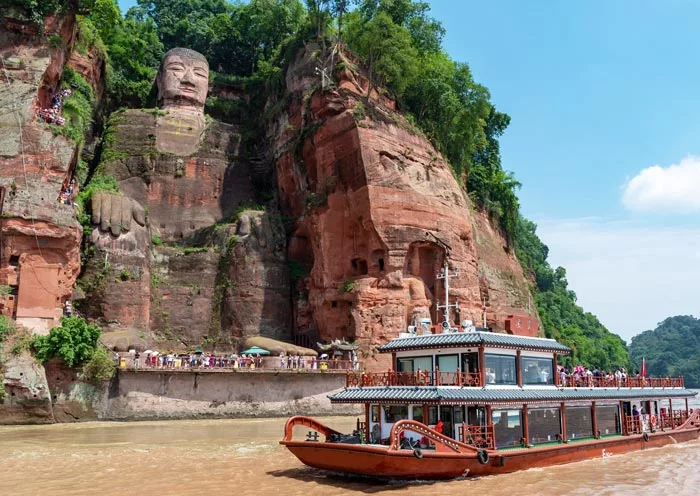
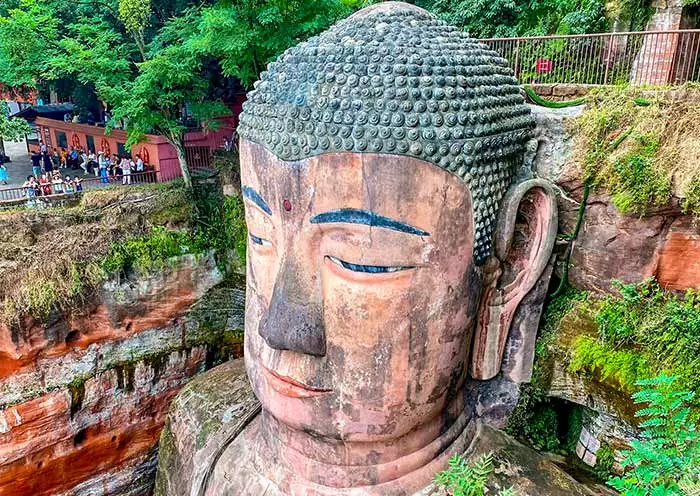
"The boat cruise takes 30 minutes and gives you the full scale — essential context. Then the cliff walk gives you intimacy — the carved folds of the robe, the fingernails, the expression of calm. Doing both in sequence creates an emotional arc: awe, then devotion. Your guide times the boat to avoid the 10am group rush."
"After the Buddha, your driver takes you to Leshan's old town for lunch. The local specialty — sweet-skinned duck (甜皮鸭) — is caramelized and crispy and unlike anything in Chengdu. Your guide knows the family stall that's been making it for 60 years. It's the reward after 250 stairs."
"Your guide points out the invisible engineering: the hair buns channel rain, the ears contain hidden pipes, the robe folds direct water away from the face. Without this 8th-century drainage system, the Buddha would have eroded centuries ago. It's a sculpture that is simultaneously a water management system — genius."
"Group tours from Chengdu arrive at 10:30am in a convoy of buses. Your private driver brings you at 8:30am — you do the cliff walk in near-solitude, then take the boat at 10am as the masses begin climbing. By the time it's crowded, you're eating sweet duck in the old town."
"Day trip from Chengdu is 2 hours each way — feasible but long. If you combine with Mount Emei, an overnight in Leshan or Emeishan is much more comfortable. Your guide arranges everything: hotel, dinner, sunrise timing for Emei's Golden Summit. Two days transforms a rushed photo stop into a meaningful Buddhist pilgrimage."
"From the boat: use a wide-angle lens to capture the full Buddha. From the cliff path: the best shots are at mid-level where you're face-to-face with the Buddha's ear. From the toes: look straight up for the dramatic perspective. Morning light from the east illuminates the face beautifully; afternoon light is harsher. Your guide positions you at each optimal point."
Travelers who stood at the toes of the world's largest stone Buddha.
The boat cruise was staggering — I've seen photos of the Leshan Buddha but nothing captures the scale until you're floating at its feet on the river. Then walking down the cliff path and standing at the actual toes, looking up 71 meters of stone face... I'm not a religious person but I felt something I can't describe. Our guide's storytelling about Monk Hai Tong who gouged out his own eye to protect the project — standing where it happened — gave me chills. This was the most powerful moment of our 3-week China tour.
We did the 2-day Leshan + Emei combination and it was absolutely the right call. Day 1: Leshan Buddha by boat and cliff walk, then sweet duck dinner in the old town (our guide's family-restaurant recommendation was incredible). Day 2: Mount Emei Golden Summit at sunrise — sea of clouds, Buddhist temples, and a view that belongs on a meditation app. Having a private guide who connected both sites through Buddhist history made it a cohesive journey, not two disconnected tourist stops.
As an engineer, I was most impressed by the drainage system. Our guide pointed out the hidden channels in the hair buns, the pipes in the ears, the water-management system built into the robe folds. 1,300 years before modern civil engineering, Tang Dynasty craftsmen solved the erosion problem so perfectly that the Buddha still stands. The combination of artistic vision and practical engineering is extraordinary. I've been telling everyone about this.
My 72-year-old mother was worried about the cliff steps. Our guide arranged a sedan chair service for the descent (two carriers brought her down comfortably) and she did the boat cruise with us. She said the boat view alone was worth the trip — and she was right. The guide was attentive throughout, never rushed us, and made sure we had water and rest stops. Perfect example of how a private tour adapts to your needs.
Tell us your travel dates. We'll arrange your private driver from Chengdu, boat cruise tickets, cliff walk guide, and a sweet-duck lunch in Leshan old town. Optional overnight extension to Mount Emei. Free itinerary draft within 24 hours.
