Your guide meets you at the Drum Tower, the southern entrance to Hefang Street — a restored Ming and Qing dynasty thoroughfare stretching 1,800 meters through Hangzhou's old city. The street is lined with two-story wooden buildings, their upturned eaves and carved beams preserving architectural styles from the 14th to 19th centuries. "Hefang was the commercial heart of Hangzhou during the Southern Song Dynasty," your guide explains. "Tea merchants, silk traders, medicine shops, and artisans have worked here for 800 years." You pass a tea house where the owner roasts Longjing tea in an iron wok visible from the street — his family has done this for four generations. Next, a medicine shop established in 1874, its wooden drawers labeled in calligraphy, the herbalist still mixing prescriptions by hand. Your guide leads you into a silk fan workshop where an artisan paints landscapes on silk stretched over bamboo frames — the same craft that made Hangzhou silk famous along the Silk Road. For lunch, your guide knows the restaurant that has been serving Dongpo pork (braised pork belly, named after the Song Dynasty poet Su Dongpo) since the Qing Dynasty — the recipe unchanged for 100 years.
Hefang Street is not just a tourist strip — it is a living museum of Hangzhou's commercial and craft heritage, where families have worked the same trades for generations.
"In a shopfront on Hefang Street, a tea master roasts Longjing leaves in an iron wok visible from the street — the same way his great-grandfather did when the Qing Dynasty still ruled China. The aroma of roasting chestnut-scented tea fills the air for half a block. Your guide introduces you, and the master pours you a cup of his family's grade — leaves from the same hillside his ancestors picked. This is not a staged demonstration for tourists. This is how he has spent every day for 40 years." — Your Hefang guide
"Established in 1874, Hu Qing Yu Tang is China's most famous traditional medicine hall — a living museum where herbalists still mix prescriptions from wooden drawers labeled in hand-painted calligraphy. Your guide explains the philosophy of Traditional Chinese Medicine as you walk through: the concept of balance between yin and yang, how herbs are classified by their 'temperature' (hot, warm, neutral, cool, cold), and why a formula might contain 12 ingredients where Western medicine would use one. You can watch an herbalist prepare a prescription from start to finish." — Your Hefang guide
"Hangzhou silk was famous along the Silk Road for a thousand years. On Hefang Street, you can watch artisans paint landscapes, calligraphy, and flowers onto silk stretched over bamboo fan frames — each fan taking 2-3 hours. Your guide introduces you to a painter who has been creating silk fans for 30 years. She shows you the brushes (wolf hair, goat hair, and mixed), the pigments (mineral-based, the same used for centuries), and how the silk is treated to accept paint. You can commission a fan with your name in Chinese calligraphy while you watch." — Your Hefang guide
"Hefang Street is the best place in Hangzhou to eat like a local. Your guide knows the restaurant serving Dongpo pork (braised pork belly named after the poet Su Dongpo) using a recipe unchanged for 100 years — the pork is braised for 6 hours until it melts. The grandmother-run wonton shop in a side alley that seats eight people. The Longjing shrimp (river shrimp stir-fried with Longjing tea leaves) at a restaurant whose chef trained in a state banquet kitchen. And the best place for 'Ding Sheng Gao' — sweet rice cakes that General Yue Fei's soldiers carried into battle 900 years ago." — Your Hefang guide
Hefang Street is Hangzhou's living heritage — tea masters, herbalists, silk painters, and chefs keeping traditions alive in Ming-Qing dynasty shopfronts.
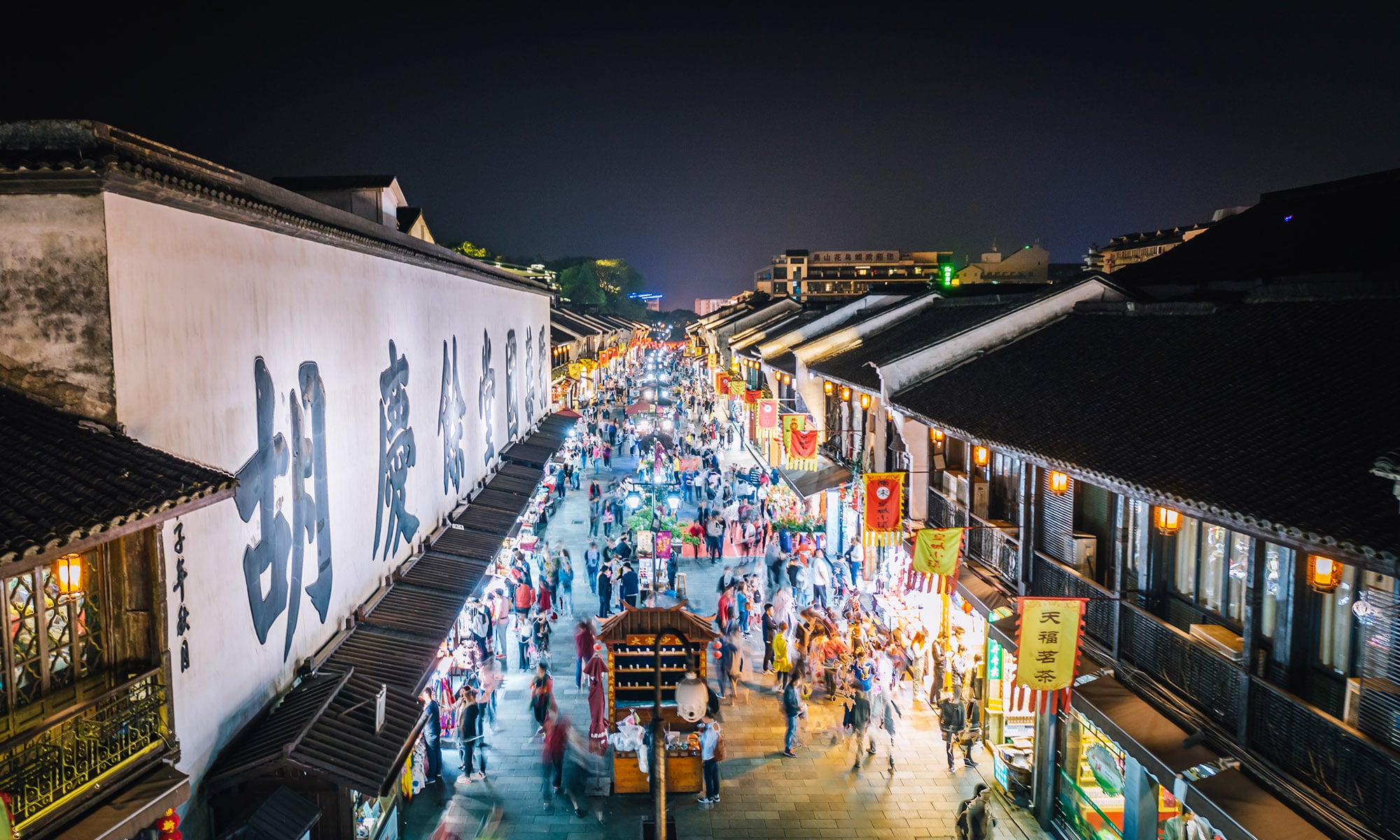

"Hefang Street is a different experience depending on when you go. Morning (9-11am): shops are just opening, you can watch craftspeople set up, the street is quiet enough to photograph the architecture. Evening (5-7pm): red lanterns light up, the street glows, and the atmosphere is festive. Your guide recommends a late afternoon visit that transitions into evening — architecture in daylight, lanterns after dark, dinner at a 100-year-old restaurant."
"Many tourists walk past the tea house without realizing what they are seeing. Your guide stops you there for 15 minutes — watching the tea master roast Longjing leaves in an open wok, smelling the chestnut aroma drift down the street, and tasting a cup of his family's tea. This 15 minutes is the most authentic experience on Hefang Street."
"Hefang Street has genuine crafts and mass-produced souvenirs side by side. Your guide steers you to the authentic: silk fans from the painter who has done this for 30 years (not the printed ones two shops down), tea from the master who roasted it in front of you, traditional pastries from the bakery using a 1920s recipe. Skip the generic 'Hangzhou' keychains and magnets."
"Hefang Street's northern end is a 10-minute walk from West Lake. The classic itinerary: morning boat on West Lake, walk through the lakefront parks, arrive at Hefang Street for a late lunch and afternoon exploration. Your guide coordinates the timing and the walking route so you experience the best of both."
"Hu Qing Yu Tang (established 1874) is one of China's most beautiful traditional buildings — carved wooden beams, a courtyard garden, and walls of wooden drawers labeled in hand-painted calligraphy. Your guide explains the fascinating basics of Chinese herbal medicine: how prescriptions are tailored to the individual (not the disease), why herbs are combined in formulas, and the logic of hot/cold/warm/cool classification. Even skeptics find it fascinating."
"The main street is restored and tourist-oriented. The side alleys are where Hefang gets real — tiny workshops, family-run restaurants, and quiet residential lanes where laundry hangs above stone-paved paths. Your guide knows which alley leads to a 90-year-old woman who still makes traditional paper umbrellas by hand, and which alley has a tea house where neighborhood retirees play Chinese chess all afternoon."
Travelers who explored Hefang Street with a private guide.
""The tea house alone made Hefang Street worth the visit. Watching the master roast Longjing leaves in an iron wok — his great-grandfather started this shop — while the chestnut aroma filled the street. Our guide translated his stories: the year the frost came late, the day he taught his son the ten roasting movements, the foreign visitor who tried to put his hand on the wok (do not do this). We bought tea directly from him at a fair price. I am drinking it as I write this.""
""I bought a hand-painted silk fan with my name in Chinese calligraphy, painted while I watched. The artisan had been doing this for 30 years — her brush strokes were so precise, so fast, it was like watching a performance. Our guide explained the symbolism of the landscape she painted (cranes for longevity, pine trees for resilience). The fan is now framed on my wall.""
""The medicine hall was completely unexpected — a 150-year-old pharmacy still operating, with wooden drawers labeled in calligraphy and an herbalist mixing prescriptions by hand. Our guide explained Traditional Chinese Medicine in a way that made sense: yin-yang balance, the four natures of herbs, why a formula has 12 ingredients. Fascinating even for a Western doctor like me.""
""The Dongpo pork at the 100-year-old restaurant was the best thing I ate in two weeks in China. Six-hour braised pork belly that literally melted. Our guide had called ahead to reserve a table — the restaurant is tiny and always full. She also took us to a side-alley wonton shop for breakfast the next morning. Both unforgettable meals, both places I never would have found on my own.""
Tell us your travel dates. We will arrange your private walk through Hefang Street, tea at the four-generation tea house, a silk fan demonstration, and dinner at a 100-year-old restaurant. Free itinerary draft within 24 hours.
