Main SitePhotosInsider TipsFAQCustom Tours
1,300 years of stilted houses and river mist — experience Fenghuang at dawn, before the tour buses. Free itinerary within 1 business day.Start Planning →
Historic Town · Hunan

1,300 Years of Stilted Houses & River Mist
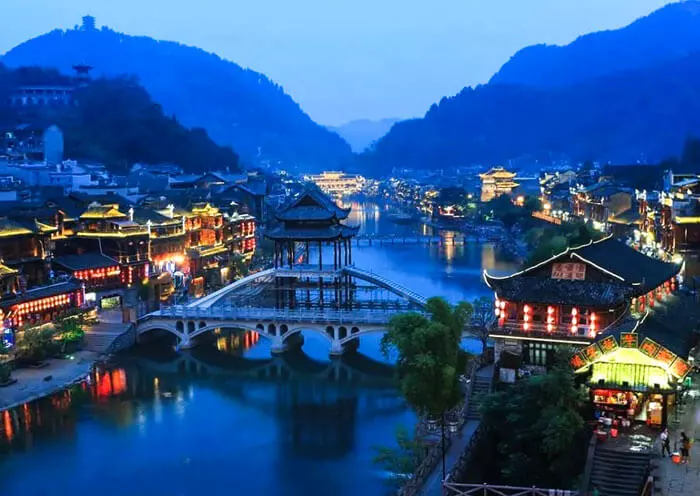
China's most beautiful ancient town — wooden houses on stilts leaning over the Tuo River, red lanterns glowing at dusk, stone-paved alleys winding past 1,300 years of history. A private guide brings you before the tour buses, when morning mist still drifts across the riverside towers and the town belongs to locals.

Fenghuang (Phoenix) Ancient Town is a living Ming-Qing dynasty settlement straddling the Tuo River in western Hunan — its stilted wooden houses (diaojiaolou) suspended over the water, its stone bridges and winding alleys largely unchanged for centuries. Named for the mythical phoenix and home to Miao and Tujia ethnic minorities, Fenghuang is famously described as "the most beautiful town in China" by New Zealand writer Rewi Alley. Your guide meets you at dawn — before the first tour bus — when the morning mist rises from the Tuo River and the stilt houses emerge from the fog like a scene from a historical scroll. Walk the ancient city wall built in 1715, cross the Hong Bridge with its covered wooden gallery, and explore the East Gate Tower where Qing dynasty soldiers once stood watch. By 10am when crowds fill the riverfront, you have already experienced Fenghuang's soul and your guide takes you to the quieter back alleys, Miao embroidery workshops, and the former residence of Shen Congwen — the writer who immortalized the town in his novel "Border Town."

★ 1,300 Years of History★ Ming-Qing Architecture★ Miao & Tujia Culture★ UNESCO Tentative List
The Guided Experience

What Makes This Special with a Private Guide

More than sightseeing — your guide reveals the stories, timing, and hidden corners that transform each place.

The Stilt Houses (Diaojiaolou) — Living Architecture

The diaojiaolou are the symbol of Fenghuang — wooden houses built on stilts that lean out over the Tuo River, their reflections rippling in the water below. Built without nails, using traditional mortise-and-tenon joinery, many have stood for 200-300 years. Your guide walks you along the riverbank at dawn, when the morning light catches the carved wooden balconies and red lanterns, and the only sound is water and the occasional splash of a cormorant fisherman's boat.

The Ancient City Wall & Gates — 300 Years of Defense

The Ming dynasty city wall, built in 1715, still encircles much of the old town. Your guide walks you along the parapet atop the North Gate Tower, where Qing soldiers once watched for bandits from the mountains. The East Gate Tower offers the best view: the Tuo River curving below, stilt houses lining both banks, and the distant green hills that inspired Shen Congwen's descriptions of the "border town" where his most famous novel is set.

Miao Embroidery & Silver — Living Craft Traditions

Fenghuang is in the heart of Miao (Hmong) ethnic territory. Your guide brings you to a small workshop in a back alley where Miao women still embroider traditional designs — phoenixes, dragons, flowers — each stitch telling a story passed down through generations. You can watch them work, ask questions (your guide translates), and purchase directly from the artisans. The Miao silver jewelry — elaborate headdresses, neck rings, bracelets — is crafted using techniques dating back centuries.

Shen Congwen's Former Residence — the Writer's Muse

Shen Congwen (1902-1988) is Fenghuang's most famous son — one of China's greatest modern writers, twice nominated for the Nobel Prize in Literature. His novel "Border Town" immortalized Fenghuang and the surrounding Xiangxi region. His former residence, a modest courtyard house in the old town, is preserved as a museum. Your guide shares excerpts from his work and explains how Fenghuang's landscape shaped his writing.
Historic Town · Hunan

In Pictures

A visual journey through the experience.

Insider Tips

Private Guide Tips

How to experience this at its best — from someone who is there every day.

Go at Dawn — Fenghuang Before the Buses

"Fenghuang receives 12 million visitors a year and the riverfront can be shoulder-to-shoulder by 10am. Your guide meets you at 6:30am at your riverside hotel. For 3 hours — 6:30 to 9:30am — the town belongs to locals washing clothes in the river, cormorant fishermen launching their boats, and the morning mist lifting from the water. You photograph the stilt houses in perfect light with almost no other tourists."

Stay Overnight — the Town Transforms at Night

"Fenghuang at night is a different world: thousands of red lanterns reflect in the Tuo River, the stilt houses glow warm gold, and the stone bridges are lit from below. After the day-trippers leave at 5pm, the town quiets. Your guide recommends a riverside restaurant for dinner — local Xiangxi dishes like sour fish hotpot and smoked bacon with garlic shoots — then an evening walk along the illuminated river."

The Back Alleys — Where Fenghuang Still Lives

"Beyond the riverfront souvenir shops, the back alleys of Fenghuang are where the real town lives. Your guide navigates the maze: a tofu workshop that has used the same stone mill for four generations, a cobbler who still hand-stitches traditional cloth shoes, a courtyard where elderly men play Chinese chess under a 200-year-old banyan tree. These alleys see few tourists."

The Boat Ride — See Fenghuang from the Water

"A 30-minute wooden boat ride on the Tuo River gives you the perspective that inspired centuries of Chinese painters and poets — the stilt houses from below, the stone bridges from underneath, the riverbanks where women still wash clothes on flat stones. Your guide arranges the first boat of the morning, when the water is still and the reflections are perfect."

Miao Culture Beyond the Town

"For travelers with an extra day, your guide can arrange a visit to a Miao village in the hills outside Fenghuang — a 40-minute drive. Here, Miao families still live in traditional wooden houses, wear embroidered clothing for festivals, and practice customs that predate the Ming dynasty. Far fewer tourists visit these villages. Your guide translates, facilitates cultural exchange, and ensures respectful interaction."

Cormorant Fishermen at Dawn

"Before the tour buses arrive, Fenghuang's cormorant fishermen launch their bamboo rafts onto the Tuo River — a tradition that has continued for over 1,000 years. The fishermen use trained cormorants with rings around their necks to catch fish. Your guide can arrange a dawn encounter: you watch from the riverbank as the birds dive and surface, the only sounds being splashing water and the fishermen's calls echoing across the misty river."

FAQ

Frequently Asked Questions

How far is Fenghuang from Zhangjiajie?
Approximately 240 km — about 3.5-4 hours by car or 1 hour by high-speed train (Zhangjiajie West to Fenghuang Ancient Town Station). Your guide can arrange private car transport or train tickets. Many travelers visit Fenghuang as a 1-2 night add-on to a Zhangjiajie trip.
Do I need a guide for Fenghuang?
You can explore independently, but a guide transforms the experience: navigating the back alleys tourists miss, arranging the dawn photography walk and first boat ride, translating conversations with Miao artisans, and sharing the history and literature that give the town meaning. Without a guide, Fenghuang is a beautiful historic town. With a guide, it becomes a story.
Is Fenghuang too touristy?
The main riverfront is busy from 9am-5pm with day-trippers and shops selling souvenirs. But the town at dawn (6:30-9am) is serene and authentic, the back alleys remain genuinely local, and the town after 5pm, when day-trippers leave, reclaims its character. A guide who knows the rhythm of the town is essential to experiencing the authentic Fenghuang.
What is the best time to visit?
Spring (March-May) and autumn (September-November) offer the most comfortable weather and the best morning mists over the river. Avoid Chinese national holidays (first week of May and October) when the town is extremely crowded. Winter (December-February) is quiet and atmospheric with mist and occasional snow on the tiled roofs.
Can I swim in the Tuo River?
Swimming is not recommended — the river is deep in sections with strong currents after rain, and water quality in a town of 50,000 residents is not suitable for swimming. The boat ride provides the water experience safely.
Trusted by Travelers

What Our Customers Say

Travelers who experienced this with a private guide.

IH
Isabella Hartmann
★★★★★
2 weeks ago
"

"The 6:30am walk with our guide was the best decision of our trip. The town was empty — just locals, mist rising from the river, and the stilt houses emerging from the fog. Our guide brought us to a tiny noodle shop in a back alley for breakfast: handmade rice noodles in pork bone broth, served by a woman who has made them every morning for 43 years. By 10am when the crowds arrived, we had already experienced the Fenghuang we came for."

DK
David Kim
★★★★★
3 weeks ago
"

"The Miao embroidery workshop in the back alley was unforgettable. Our guide translated as the artisan explained the meaning behind each stitch — the phoenix for rebirth, the dragon for protection, the flowers for prosperity. We bought a small piece directly from her. The back alleys our guide navigated — a tofu workshop, an elderly cobbler, chess players under a banyan tree — were the real Fenghuang."

PL
Pierre Lacroix
★★★★★
1 month ago
"

"Fenghuang at night is pure magic — thousands of red lanterns reflected in the Tuo River, the stilt houses glowing warm gold, and after 5pm when day-trippers leave, the town becomes quiet and romantic. Our guide recommended a riverside restaurant where we ate sour fish hotpot — a local Xiangxi specialty — while watching the lanterns come on one by one. The boat ride the next morning, first boat at 7am with the river like glass, was perfect."

AY
Aiko Yamamoto
★★★★★
1 month ago
"

"As a literature lover, visiting Shen Congwen's former residence with a guide who could share excerpts from 'Border Town' was deeply moving. She read a passage describing the Tuo River at dawn, and then we walked outside and saw exactly what Shen had described — the mist, the river, the wooden houses. The connection between literature and landscape was palpable. Fenghuang is not just beautiful — it is meaningful."

See more reviews on Google Maps

Walk Through 1,300 Years of History — at Dawn, When Fenghuang Is Still Real

Tell us your dates. We'll arrange your private guide, a dawn photography walk, the first boat of the morning, and a riverside hotel. Free itinerary draft within 24 hours.

Plan My Tour →Back to Zhangjiajie