Your guide brings you to a quiet bend of the Li River as the sun begins to set. An 80-year-old fisherman — Master Huang — is already on the water, poling his bamboo raft with the same motion his father and grandfather used. His cormorants perch on the raft's edge, sleek black birds with piercing green eyes. At his signal, they dive — disappearing beneath the dark water, resurfacing moments later with fish held in their beaks. A cord around each bird's neck prevents swallowing; the master retrieves the fish with practiced hands. Between dives, Master Huang talks — through your guide's translation — about learning this craft at age 12, about a time when 200 fishermen worked this stretch of river, about training birds that become like children to their masters. When the last light fades, he lights a lantern on his raft. The flame reflects on the water. The birds rest. And you realize you've witnessed something that may not exist in 20 years.
Tourist versions of cormorant fishing exist — staged for cameras, rushed, transactional. A private guide brings you to a real master on a quiet stretch of river, where the birds actually fish, and the stories are told by the man who lived them.
"Master Huang was 12 years old when his father first took him onto the Li River with a bamboo raft and two cormorant chicks. For 68 years, he has fished this stretch of river — through wars, through the Cultural Revolution, through the transformation of Guilin from a quiet river town to an international tourist destination. He has trained more than 100 birds in his lifetime. Each one had a name. Each one he buried with ceremony when they died. Your guide has known Master Huang for 15 years and translates every word of his stories." — Your guide
"Cormorants are natural hunters — they can dive 10 meters deep and hold their breath for over a minute. The masters train them from chicks, building a bond that lasts 10-15 years per bird. A cord tied loosely around each bird's neck prevents swallowing large fish (they can still eat small ones). When a bird catches a fish, it returns to the raft, the master retrieves the fish, and rewards the bird with a small piece. The trust between bird and master, built over years, is the art of this tradition." — Your guide
"In the 1950s, over 200 cormorant fishermen worked the Li River between Guilin and Yangshuo. Today, fewer than a dozen remain — all over 60 years old. Their children have gone to cities for modern jobs. No young person wants to spend 12 hours a day on a bamboo raft training birds. Your guide brings you to Master Huang not just for a performance, but to document, to listen, to help preserve — if only in memory — a way of life that has existed on this river for a thousand years." — Your guide
"The fishing happens at dusk — the golden hour on the Li River. Your guide knows the best position on the riverbank: close enough to see the birds dive, far enough to frame the bamboo raft against the karst peaks. The lantern light on the water at the end of the session is the money shot — a flame reflected on the dark river, the master's silhouette, the birds resting on the raft. Your guide helps you get the shot while staying respectful of the moment." — Your guide
Cormorant fishing in three acts — the birds poised on the bamboo raft, the dive and catch, and the lantern-lit return at twilight.

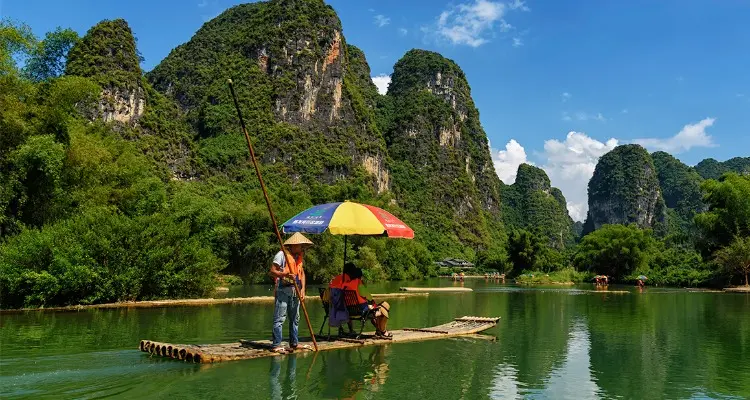
"Cormorant fishing happens at dusk — the birds hunt better in low light. Your guide arranges a 5:30-7pm session (seasonally adjusted). Arrive 15 minutes early to watch Master Huang prepare his raft and birds. The session ends after dark when the lantern is lit — this is when the most magical photos happen."
"The birds dive fast and the light is fading — a challenging combination for photography. Your guide recommends: shutter speed 1/500 or faster to freeze the dive, ISO 1600-3200 as the light drops, and a zoom lens (70-200mm) for close-up shots of the birds. For smartphone: use burst mode during dives and night mode for the lantern-lit final scenes."
"Each master has one bird that is their favorite — the one they've had longest, the one that catches the most fish, the one with personality. Ask your guide to translate this question. Master Huang's current favorite is a 12-year-old cormorant named Black Pearl (Hei Zhenzhu). He raised her from an egg when her mother died. The story of their bond — 12 years of dawns and dusks on the Li River — is the kind of thing no tourist show ever includes.
"The session ends around 7pm as darkness falls. Your guide knows a riverside restaurant 10 minutes away where you can eat the fish caught by the cormorants that evening — a tradition called 'eating the catch.' The restaurant cooks Li River fish simply: steamed with ginger and scallions, or braised with local beer and peppers. Eating fish caught by birds you just watched dive into the river — it's the most direct farm-to-table experience possible."
"Cormorant fishing happens year-round but is most atmospheric in autumn (September-November) when the dusk light is golden and the river is calm, and winter (December-February) when mist rises from the water and the lantern light glows through the fog. Summer sessions are possible but the light is harsher and mosquitoes are active. Spring brings occasional rain — atmospheric but wet."
"Some tour operators offer 'cormorant fishing shows' during daylight hours with handlers who are not real fishermen. These are performances, not traditions. Your guide brings you to Master Huang — a man who has fished this river for 68 years, who depends on his birds for part of his livelihood, and whose stories are his own. The difference is everything. Come with respect, not just a camera."
Travelers who witnessed cormorant fishing on the Li River.
"I came for the photos and left with a profound appreciation for a vanishing culture. Master Huang's hands — worn from 68 years of poling a bamboo raft — told a story no museum could. When he talked about Black Pearl, his favorite cormorant, through our guide's translation, there were tears in his eyes. These birds are his family. The moment the lantern was lit on the dark river, with the karst peaks silhouetted behind — it was the most beautiful thing I saw in China."
"As a wildlife photographer, I was skeptical about 'cormorant fishing' — I expected a tourist show. Master Huang is the real thing. Our guide has known him for 15 years and the trust between them was evident. Master Huang showed us photos of himself as a 20-year-old with his first cormorant. The birds dove 8-10 times and caught fish almost every time. The lantern-lit finale — with my shutter at 1/60, ISO 6400 — produced my favorite photo from the entire trip."
"The cormorant fishing experience was the most unexpected highlight of our Guilin trip. Our guide arranged everything perfectly — we arrived just as the light was turning golden, watched the birds dive and catch fish for an hour, then ate those same fish (steamed with ginger) at a riverside restaurant afterward. The full circle of the experience — watching the tradition, then tasting its result — was something I'll never forget."
"I almost skipped this because I was worried about the ethics. Our guide addressed my concerns openly and respectfully, explaining the birds' care, their bond with Master Huang, and the reality that this tradition is dying out. Watching Master Huang work with his birds — the whistles, the hand signals, the gentle way he retrieved the fish and rewarded each bird — changed my perspective. This is a partnership, not exploitation. I'm grateful I went."
Tell us your travel dates. We'll arrange your private dusk session with Master Huang, position you for the best viewing and photography, translate every story, and book the riverside dinner where you eat the catch. Free itinerary draft within 24 hours.
