Your guide meets you at the entrance to the China National Tea Museum, a sprawling complex of pavilions set among the very tea terraces that produce Longjing tea. "This is the world's only national museum dedicated entirely to tea," your guide says. "And it is free." The museum spans four halls, each covering a different era of tea history. Hall 1 traces tea from its legendary discovery by Emperor Shennong in 2737 BC through the Tang Dynasty, when Lu Yu wrote The Classic of Tea — the world's first tea book. Your guide points to a Tang Dynasty silver tea grinder, explaining how tea was compressed into bricks, shaved, ground to powder, and whisked into froth — the precursor to Japanese matcha. Hall 2 covers the Song Dynasty, when tea competitions judged the quality of the froth. Hall 3 documents the Ming Dynasty revolution — when loose-leaf tea replaced powdered tea, giving birth to the brewing methods we use today. In Hall 4, you see tea varieties from every province in China: white tea from Fujian, pu'er from Yunnan, oolong from Guangdong, and of course, Longjing from the terraces visible through the window. Your guide concludes at the tasting room, where you sample three teas while overlooking the hills where Longjing leaves are picked each spring.
The China National Tea Museum is not just artifacts in glass cases — it is a sensory journey through 5,000 years of tea, from Silk Road tea bricks to the Longjing leaves growing outside.
"The Tang Dynasty (618-907 AD) is when tea became art. In this hall, your guide shows you a silver tea grinder from the 8th century — tea was compressed into bricks, shaved, ground to powder, and whisked into a green froth. This is exactly how Japanese matcha is still made today. Your guide explains Lu Yu's Classic of Tea — the world's first tea book, written in 760 AD, which codified everything from water temperature to the ideal cup shape. You will never look at a cup of tea the same way." — Your museum guide
"In the Song Dynasty (960-1279 AD), tea was a competitive sport. Connoisseurs gathered to see who could produce the most perfect green froth — white, fine, and long-lasting. Your guide shows you the tools: a tea mill, a whisk carved from a single piece of bamboo, and tea bowls glazed black specifically to make the green froth stand out. These competitions determined social status. A perfect froth meant you were cultured. A collapsing froth meant you were not invited back." — Your museum guide
"The Ming Dynasty (1368-1644 AD) changed tea forever. The Hongwu Emperor, tired of the elaborate powdered tea rituals, ordered that tea be brewed from loose leaves instead. This single decree created the entire world of loose-leaf tea we know today — green, white, oolong, black. Your guide shows you the first Yixing clay teapots, which absorb tea oils over decades and eventually brew tea without any leaves at all. One pot on display has been in continuous use for 200 years." — Your museum guide
"The museum's tasting room overlooks the Longjing tea terraces, and your guide arranges a private tasting of three teas from different regions and processing methods. You taste the differences between green tea (unoxidized, fresh, grassy), white tea (minimally processed, delicate, sweet), and oolong (partially oxidized, complex, floral). Your guide explains why Longjing leaves must be picked before Qingming Festival — after that, the leaves are too large, the flavor too coarse. The view from the tasting room alone is worth the visit." — Your museum guide
From a Tang Dynasty silver tea grinder to the Longjing terraces visible through the windows — the China National Tea Museum is a journey through every era of China's most important cultural export.
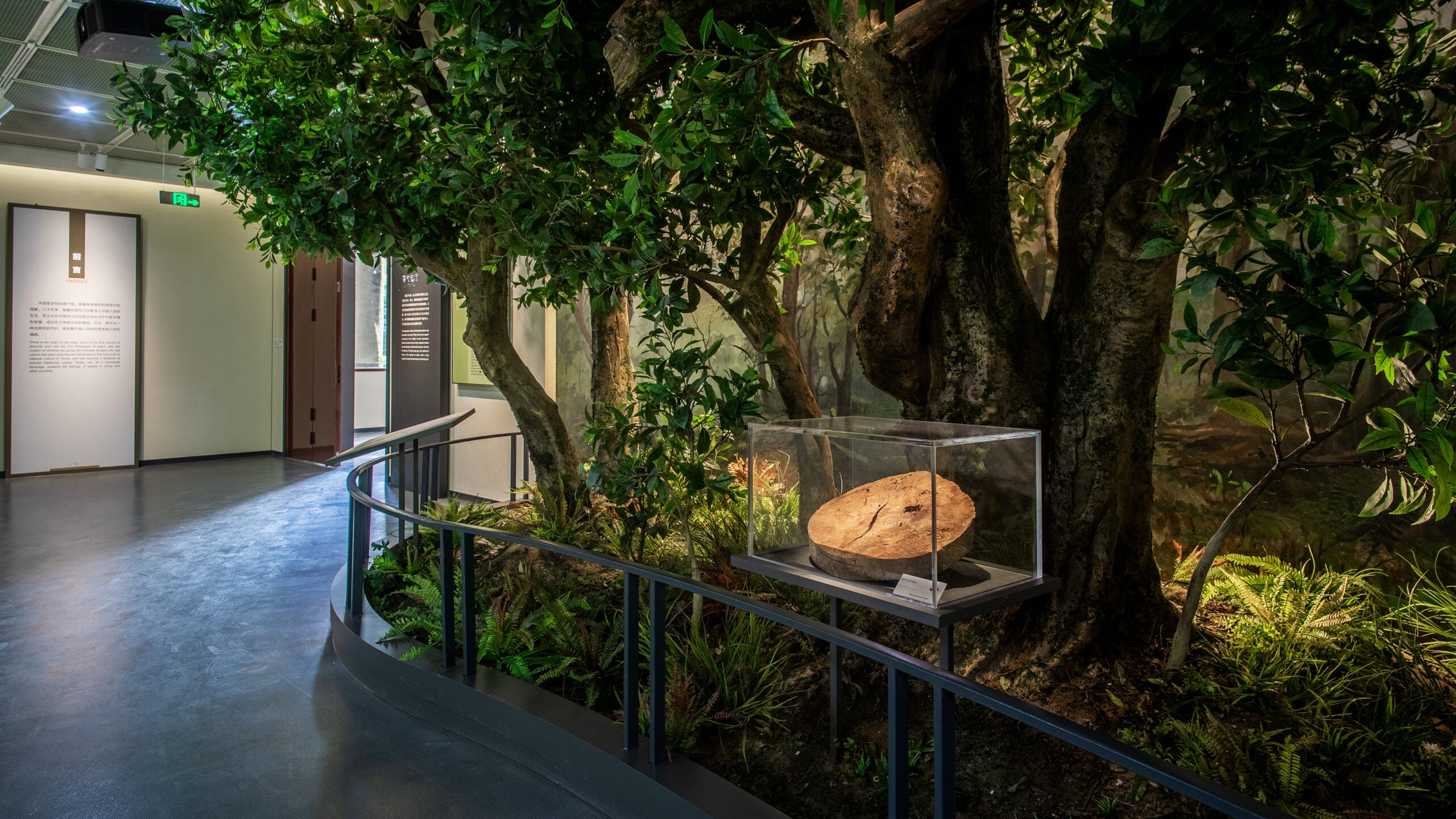


"The China National Tea Museum is free to enter, but without a guide, you walk past 5,000 years of history in 30 minutes without understanding any of it. Your guide transforms the visit: identifying the 1,200-year-old Silk Road tea brick you would have walked right past, explaining why the Song Dynasty tea bowls are black (to make green froth visible), and connecting each exhibit to the Longjing tea you tasted at the plantation that morning."
"The museum is 5 minutes from Longjing Village. The ideal itinerary: morning at the museum for the history and theory, then afternoon at Longjing Village to watch a tea master roast leaves in an iron wok and taste six grades. Museum first (understand) → plantation second (experience). This is the complete tea education in one day."
"In Hall 1, one unassuming dark block is a 1,200-year-old tea brick recovered from a Silk Road trading post. Tea traveled from China to Tibet, Central Asia, and eventually Europe along these routes. Your guide explains that tea bricks were so valuable they were used as currency — a brick of pu'er tea could buy a horse. You can see the pressed leaf patterns still visible after a millennium."
"The museum has an interactive section where you learn to identify the six categories of Chinese tea by appearance, aroma, and taste. Green (unoxidized, grassy), white (minimally processed, sweet), yellow (rare, mellow), oolong (partially oxidized, complex), black (fully oxidized, bold), and dark/post-fermented (aged, earthy, like pu'er). Your guide arranges a comparative tasting that makes these distinctions immediately clear."
"The Yixing clay teapot is the holy grail of Chinese tea brewing. Made from purple clay found only near Yixing, these pots are unglazed — the porous clay absorbs tea oils over decades of use. Your guide shows you the museum's collection, including a pot that has been in continuous use for 200 years. Pour hot water into it, and the absorbed tea oils flavor the water without any leaves. This is why tea connoisseurs dedicate one pot to one type of tea for life."
"The museum shop is one of the few places in Hangzhou where tea quality is guaranteed — the museum's reputation depends on it. Your guide helps you select authentic Longjing tea at fair prices, from everyday grade to pre-Qingming. The shop also sells tea ware: gaiwan (lidded cups), Yixing pots, and bamboo tea tools. Your guide explains what is worth buying and what is mass-produced."
Travelers who explored the China National Tea Museum with a private guide.
""I am a tea educator in Japan and I was blown away by this museum. The Tang Dynasty exhibits alone — the silver tea grinder, the reconstructed tea ceremony implements — showed me exactly where Japanese tea culture originated. Our guide connected every exhibit to modern tea practices. Without her, I would have learned half as much in twice the time. The private tasting overlooking the Longjing terraces was the perfect ending.""
""I walked into this museum knowing nothing about tea except that I like drinking it. I walked out feeling like I understood a 5,000-year-old culture. Our guide was incredible — she made the Tang, Song, and Ming dynasties come alive through tea. The story of tea bricks being used as currency on the Silk Road, the Song Dynasty tea competitions, the Ming emperor who changed tea forever with a single decree — I will never forget any of it.""
""The combination of the Tea Museum and Longjing Tea Plantation was the best day of our Hangzhou trip. Museum first — all the history and context. Then the plantation — watching a tea master roast leaves, tasting six grades. By the end, I could identify green vs white vs oolong by smell alone. Our guide was a tea expert and her enthusiasm was contagious. I bought 500g of Longjing at the museum shop and have been brewing it properly ever since.""
""The Yixing teapot exhibit was the highlight for me. Our guide explained that the unglazed clay absorbs tea oils over decades, and showed us a pot that has been in use for 200 years — pour hot water into an empty pot and it brews tea from memory. The museum shop had affordable Yixing pots, and our guide helped me select one and explained how to season it. I use it every morning now.""
Tell us your travel dates. We will arrange your private museum guide, tea tasting in the pavilion overlooking Longjing terraces, and a combined visit to the Longjing Tea Plantation. Free itinerary draft within 24 hours.
