What Makes This Special with a Private Guide
More than sightseeing — your guide reveals the stories, timing, and hidden corners that transform each place.
Huanglong Cave — a Subterranean World
Over 15 km of passages across four vertical layers, with only 3 km open to visitors — the rest remains wild and unexplored. Your guide walks you through chambers with names like Dragon Palace, Terrace of the Immortals, and Crystal Palace. The Dragon Palace is the showpiece: a cavern 140 meters high, large enough to hold a 10-story building, with thousands of stalactites hanging from the ceiling like a petrified waterfall. An underground river flows through the lower level — you board a small boat and drift through phosphorescent-lit passages where the ceiling drops low enough to touch.
Baofeng Lake — the Mirror Between Peaks
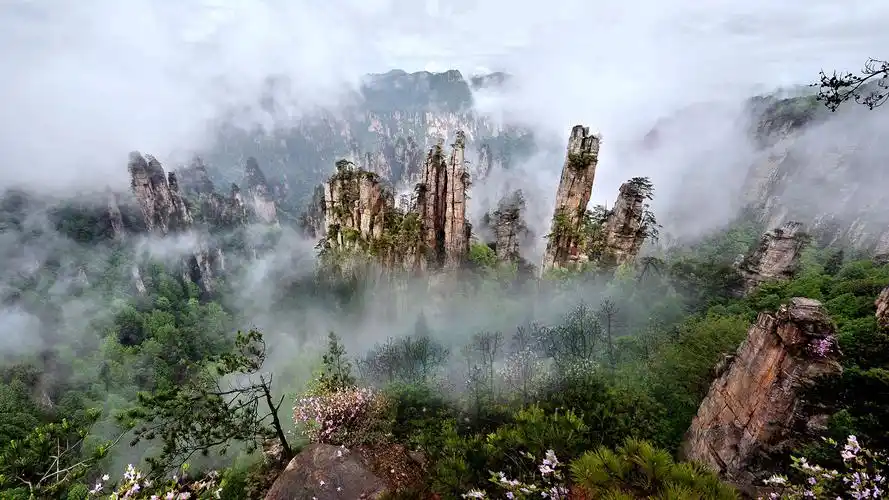
Baofeng Lake sits at 400 meters elevation, fed by mountain springs and rainfall. The water is so still that the surrounding sandstone peaks reflect perfectly — a mirror surface broken only by your wooden boat's wake and the dipping oar of the boatman. The lake covers 20 hectares, with depths reaching 72 meters in places. Your guide arranges the first boat of the morning — 8am, when the water is at its calmest and the morning light fills the basin. The boat ride lasts 30-40 minutes, circling the lake as sandstone cliffs rise on all sides.
Tujia Folk Songs on the Water
As your boat glides across Baofeng Lake, Tujia singers in traditional dress appear on the shore or in a small boat — their folk songs echo across the water in the local dialect, accompanied by the splash of oars. The songs tell stories of love, harvest, and the mountains. Your guide explains the meaning of each song. This is not a staged tourist performance — it is a living Tujia tradition that the community has maintained for generations.
How Were They Formed? — 380 Million Years of Geology
Your guide explains the geology that created both cave and lake: 380 million years ago, this region was a shallow sea. The accumulated shells and skeletons of marine organisms compressed into limestone. Over eons, slightly acidic rainwater dissolved the limestone, carving the cave system. Baofeng Lake formed when a section of the limestone basin collected mountain runoff — a natural reservoir held between sandstone peaks. The formations you see in the cave are still growing — at roughly 1 cm per century.