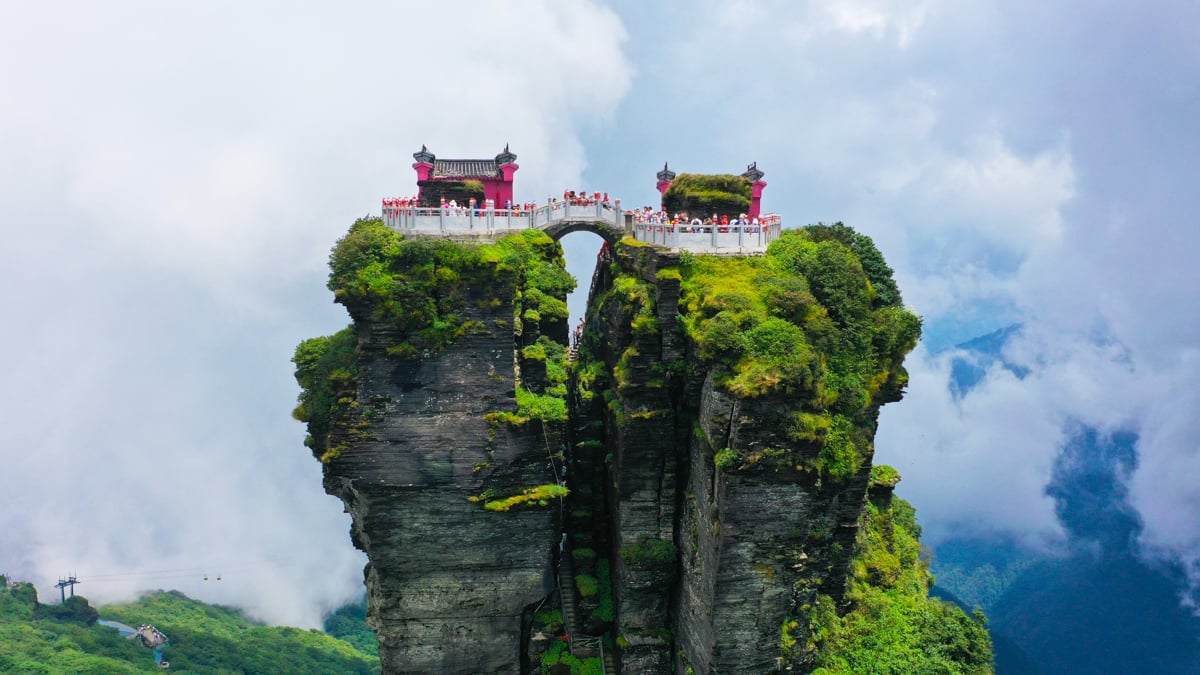
Mount Fanjing, the main peak of the Wuling Mountain Range, reaches an elevation of 2,572 meters. It covers a total area of 775.14 square kilometers, consisting of a 402.75-square-kilometer heritage site and a 372.39-square-kilometer buffer zone.
Mount Fanjing is one of the first areas in Southern China to have risen from the ocean to become land—a process that began approximately 1.4 billion years ago. Situated within a subtropical humid monsoon climate zone, the mountain preserves a pristine subtropical ecosystem and serves as a refuge for ancient, rare species dating back 70 million to 2 million years. It is home to over 7,100 species of wild flora and fauna and remains the sole habitat of the Guizhou snub-nosed monkey.
With a cultural history spanning more than 2,000 years, Mount Fanjing is a renowned mountain in Southwest China. As early as the Spring and Autumn and Warring States periods, it was part of the "Qianzhong" region under the State of Chu; it later became "Qianzhong Commandery" during the Qin Dynasty and "Wuling Commandery" during the Han Dynasty. Throughout subsequent history, it has been revered as a sacred, divine mountain by the "Wuling Man" (the indigenous peoples of the Wuling region). Buddhism took root on Mount Fanjing during the Tang Dynasty and flourished during the Ming Dynasty. An imperial stele erected during the Wanli reign of the Ming Dynasty hails Mount Fanjing as the "progenitor of all famous mountains under heaven"—a site that "stands firm as the heavens and earth, enduring through the ages in unparalleled prominence."